
Reviewed · BOSTON SELF-GUIDED TOURS
Plymouth Pilgrims Self-Guided Walking Audio Tour
Plymouth’s landmarks make more sense when you connect them on foot: the Mayflower, Plymouth Rock, a centuries-old cemetery, and houses tied to early colonial families all sit within a larger story. This self-guided tour uses GPS-triggered audio to guide you between more than 24 stories, with no group to keep up with and no fixed start time.
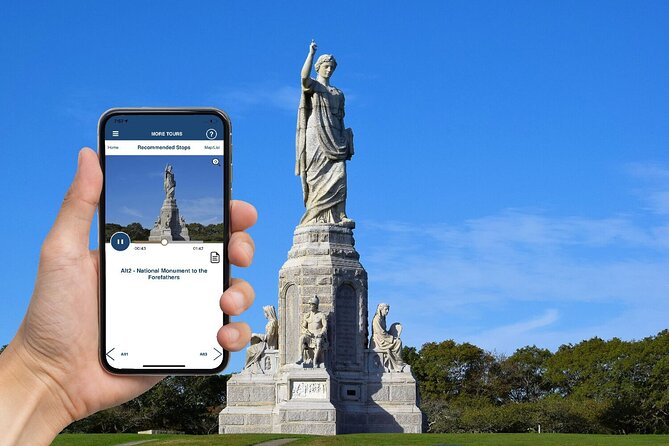
I like the freedom to pause and explore: you can stop for a snack, take a side trip, or return to the audio later. I also like that the tour includes more than the best-known Pilgrim sites, adding places such as Brewster Gardens, the Richard Sparrow House, and the National Monument to the Forefathers.
The main caution is the app. Some stops have not triggered reliably, and you need to download the tour in advance over a strong connection. The route also includes a steep hill near the end, so pace yourself and check the map before setting out.
What to know before you walk

- More than 24 audio stories: The route is listed as over a mile, with a walking time of about one to two hours. The broader estimate is two to three hours, depending on your pace and stops.
- A flexible schedule: Start, pause, skip stories, or resume later. Your access does not expire.
- Several kinds of Plymouth history: The stops range from Mayflower landmarks and colonial houses to gardens, a working mill site, and a monument.
- Admission is separate: The $14.99 price covers the audio tour, not entry tickets, museum visits, or reservations.
- Download before you go: Set up the separate Action app and download the tour while you have strong Wi-Fi or cellular service.
- A hill and some tech uncertainty: The tour is not a guided group walk. GPS and app performance can vary, and the route has a steep climb near the end.
A walking introduction to Plymouth’s Pilgrim story
This is a self-guided audio walk from Stories with Action, not a live tour with a guide waiting at the start. You follow the route on your phone, and location-based stories are meant to play as you reach each point. The narration is in English, and extra stories let you spend longer on subjects that catch your interest.
The listed starting point is 136 Water Street, near the Plymouth Visitor Information Center. The tour’s first section gives you background before you reach some of the major sights. That means the Mayflower may not be the first thing you hear about, even though it is one of the route’s headline stops. If someone in your group has limited stamina, this early stretch is worth keeping in mind.
The route description says it covers more than a mile, but the overall time estimate ranges from one to three hours. The difference is likely down to how long you stop, how much bonus audio you play, and whether you explore nearby sites. Treat the clock as a guide, not a promise. A quick walk through the stories can be shorter; adding museum visits or a long pause can stretch the outing.
There is also a detail to check before you leave: the listed end point is Plimoth Patuxet Museums at 137 Warren Avenue, while the route is described as a walk of just over a mile. Open the app map before starting so you understand the route and where it finishes. The audio itself does not include admission to the museum or any other attraction.
More Plymouth trips around Boston:
- Boston to Plymouth Day-Trip including Quincy, Plimoth Patuxet and Mayflower II
★ 5.0 · 407 reviews - From Boston: Quincy, Plymouth, and Mayflower II Day Trip
★ 4.9 · 102 reviews - From Boston: Cape Cod and Plymouth Day Tour
★ 4.4 · 21 reviews
Mayflower II and the first landmarks
The tour starts near the visitor information center, a useful place to get your bearings. One important practical note: the audio may not begin with a dramatic landmark right at the door. The first story is tied to the starting point, but the walk to the major highlights takes a little time. Start at the designated location and follow the audio cues rather than trying to jump ahead.
Mayflower II is a full-scale reproduction of the ship that carried the Pilgrims to the New World in 1620. Built in Devon, England, in 1955 and 1956 through an English-American collaboration, it gives the story a physical scale that a plaque or map cannot. You can hear the tour’s account outside, but the audio price does not cover boarding or any separate admission.
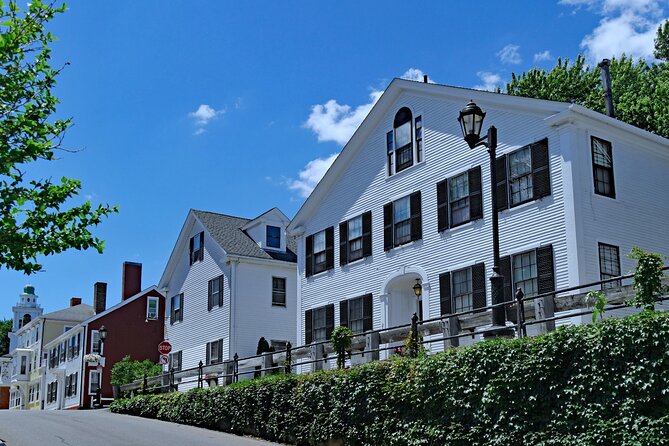
Across the street and up the hill, the Mayflower Society House adds a different angle. Built in the eighteenth century and associated with Edward Winslow’s descendants, the home carries stories across several generations. The audio points to the Winslow family’s Loyalist ties during the Revolutionary era, the wedding of Ralph Waldo Emerson and Lydia Jackson, a restoration by architect Joseph Everett Chandler, and the house’s use as a Red Cross headquarters during World War II. You hear about the house from the route; do not assume the interior is open as part of the tour.
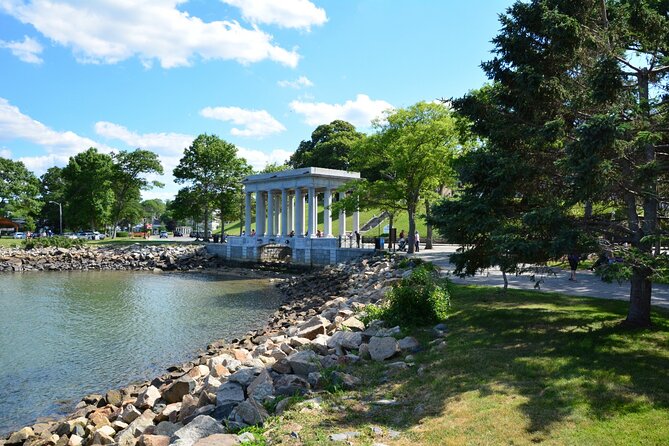
Plymouth Rock is the traditional landing site associated with the Pilgrims’ arrival in December 1620. It is a small physical object carrying an outsized place in the national story, so expectations matter. The audio can provide context, but the rock itself is not a grand monument. Nearby, the Massasoit statue depicts the Pokanoket leader welcoming the Pilgrims, a reminder that the story of Plymouth also involves Indigenous people and relationships.
Gardens, graves, and early homes
Brewster Gardens offers a gentler stretch between headline sights. Named for Mayflower passenger William Brewster, the park gives you a break from street walking and a chance to listen while moving through a green public space. The Pilgrim Maiden statue, created by Henry Hudson Kitson in 1922, honors English women who came to the colony. A later stainless-steel sculpture recognizes Plymouth’s immigrant settlers from 1700 to 2000, extending the story beyond the first generation.
Burial Hill, also called the Old Burial Ground, is one of the route’s most historically weighty stops. Established in the seventeenth century, it is the burial place of several Pilgrims and founding settlers. Give yourself a little time here: a cemetery asks for a slower pace than a quick photograph. The stop can also help you understand how close Plymouth’s living town and early colonial history remain to one another.
The Richard Sparrow House, built around 1640, is described as Plymouth’s oldest surviving house. Its first owner, Richard Sparrow, was an English surveyor who arrived in Plymouth in 1636. The building’s age makes it a useful counterpoint to the more familiar Mayflower story: the colony’s history is not only a moment of arrival, but also the decades of homes, work, and community that followed. The tour does not include entry.
The Plimoth Grist Mill is a working reconstruction of the original Jenney Grist Mill, built on the original site. A mill helps make the past practical: settlements needed ways to process food, not just places to hold meetings or mark a landing. The Pilgrim Hall Museum, another listed point, opened in 1824 and has operated continuously as a public museum. It is a separate attraction, so check its opening arrangements if you hope to go inside.
Monuments and houses beyond the familiar story

The National Monument to the Forefathers is a striking change of scale after the smaller historic sites. Dedicated in 1889, it commemorates the Pilgrims and ideals later embraced by the United States. It is thought to be the world’s largest solid granite monument. The audio can help you read its purpose and symbolism, which is useful because a large monument can otherwise amount to a quick look and a photo.
Hedge House, built in 1809 for sea captain William Hammatt, brings the route into a later period. The Hedges, a family of entrepreneurs, bought it in 1830 and lived there until 1919. The included information also describes an interpretive center whose exhibits address the Pilgrims, faith and values, abolition and slavery, and family life. These themes broaden the walk beyond a single account of colonial settlement.
The Jabez Howland House is another early home in the itinerary. Its oldest section dates to 1667, and it was later owned by Jabez Howland, son of Mayflower passengers John and Elizabeth Tilley Howland. As with the other historic houses, the audio stop is not an entry ticket. If a house museum is a priority, check its opening hours and admission separately before you plan the day around it.
Long Beach Rock is identified as a barrier beach, a narrow stretch separating open ocean from the mainland coast. This stop shifts the focus from buildings and memorials to the shoreline. The route’s final destination is listed as Plimoth Patuxet Museums, a living history museum that presents the seventeenth-century Plymouth settlement. The audio tour and museum visit are separate experiences, so plan extra time and admission if you want to explore the museum itself.
More self-guided tours around Boston:
- Boston Premium Small Group Driving Tour With Boat Cruise
★ 4.5 · 259 reviews - Self Guided Classic Freedom Trail Location Aware (GPS) Walking Audio Tour
★ 4.5 · 258 reviews - Boston Freedom Trail Self-Guided Tour with Audio Narration & Map
★ 4.5 · 98 reviews - Boston Sightseeing Tour – a fully-narrated driving tour
★ 5.0 · 57 reviews
Making the app work for you

The audio is designed to play automatically when you reach a story point. In practice, GPS-triggered audio can be less dependable than a person giving directions. If a story does not start, the app may require you to launch it manually or reopen the app. Keep the route map handy and check that you are at the correct starting point before troubleshooting.
Before your visit, search your email and texts for the setup instructions and password. Download the separate Action tour app, enter the password, and download the tour while you have a strong signal. Once the files are on your device, the tour works offline. Headphones or earbuds make the walk easier, especially on streets where you want to hear the narration without holding your phone to your ear.
The tour can be used on the same number of devices as the number of people booked, with the same password entered on each device. The provider also suggests that a couple can share one tour by splitting headphones. The app is recommended for an iPhone running iOS 15 or later, an Android device running version 9 or later, or an iPad or tablet with GPS and cellular connectivity.
Access is listed as lifetime, with no expiry, so you can pause and return on another day or use the audio again on a future visit. That is a useful perk if your schedule changes, though it does not remove the need to download the tour before you head out.
Is $14.99 good value?
At $14.99 per person, this tour is priced as a modest, independent history experience rather than an all-in attraction pass. You get a narrator, a route, offline maps, location-based audio, and additional stories. For someone who wants a flexible introduction to Plymouth without booking a set-time group walk, that can be good value.
The comparison changes if you are used to low-cost audio apps or want a very polished, tightly directed route. The price has drawn criticism from people who felt the story content did not justify the cost, and app or map trouble can quickly make a budget tour feel less like a bargain. You are paying for convenience and lifetime access as much as for the walk itself.
The tour is most useful when museums are closed, when you want to explore at your own pace, or when you prefer stopping for side trips without holding up a group. The audio can still give your visit shape even if interiors are unavailable. But if your main goal is to go inside several houses or museums, budget separately for admission and check opening times before you book.
The route is private to your own group, but it is not a personal guided tour: no one meets you at the starting point, and support may be needed if the app misbehaves. Free cancellation is available up to 24 hours before the experience; within 24 hours, the payment is not refunded.
Should you book the Plymouth Pilgrims walk?

Book it if you want a flexible, audio-led way to connect Plymouth’s well-known landmarks with less obvious stops, and you are comfortable navigating with a phone. It is especially handy when you want to set your own pace or find some historical context even when attractions are closed.
Think twice if reliable app navigation is essential, you do not want to download software in advance, or a steep hill could limit your walk. Before paying, check the route map and listed finish, then decide whether the audio and lifetime access are worth $14.99 to you. If they are, download everything at home and bring headphones.
FAQ

How long does the tour take?
The route is described as over a mile and takes about one to two hours to complete. The overall estimate is two to three hours, depending on your pace and stops.
What language is the audio tour in?
The tour is offered in English.
Where does the tour start?
The listed starting point is 136 Water Street, Plymouth, Massachusetts, near the Plymouth Visitor Information Center. No guide meets you there.
Where does the tour end?
The listed end point is Plimoth Patuxet Museums at 137 Warren Avenue, Plymouth. Check the app map before setting out so you understand the route and finish.
Does the price include museum admission?
No. Attraction passes, entry tickets, and reservations are not included in the $14.99 price.
Does the tour work without internet?
Yes. You must download the tour while you have strong Wi-Fi or cellular service. After downloading, it works offline.
What do I need to use the tour?
You need the separate Action audio tour app and the password sent by email and text. Headphones or earbuds are recommended. The suggested devices are an iPhone with iOS 15 or later, an Android device with version 9 or later, or an iPad or tablet with GPS and cellular connectivity.
Can I pause the tour and continue later?
Yes. You can start and pause whenever you like, take breaks, skip stops, and return later. Access does not expire.
Can I cancel for a refund?
You can cancel at least 24 hours before the experience for a full refund. Cancellations or changes made less than 24 hours before the start time are not accepted for a refund.
More walking tours around Boston
- Boston: Freedom Trail History Small Group Walking Tour
★ 5.0 · 6,450 reviews - Harvard University Campus Guided Walking Tour
★ 4.5 · 3,632 reviews - Boston Freedom Trail Walking Tour with Costumed Guide
★ 4.5 · 2,531 reviews - The Full Revolutionary Story Epic Small Group Boston Walking Tour
★ 5.0 · 2,356 reviews
Just added around Boston
- Boston’s Freedom Trail: A Self-Guided Tour of All 16 Sites★ 5.0 · 14 reviews
- Boston’s Freedom Trail: A Self-Guided Audio Tour★ 4.0 · 18 reviews
- Private Walking tour of Boston’s Freedom Trail and more!★ 5.0 · 29 reviews
- Boston Self-Guided Audio Tour Bundle: Freedom Trail & More★ 4.5 · 5 reviews
- Washington D.C. Cherry Blossom,Baltimore 3-Day Tour from Boston★ 4.5 · 7 reviews
- Tour-in-Four — A Private four hour walking & driving city tour★ 5.0 · 32 reviews
- Freedom Trail Experience★ 5.0 · 8 reviews
- Tour de Cambridge Guided Bicycle Tour★ 5.0 · 34 reviews
Boston Self-Guided Tours, compared.

Boston Premium Small Group Driving Tour With Boat Cruise
Read our review →
Self Guided Classic Freedom Trail Location Aware (GPS) Walking Audio Tour
Read our review →
Self-Guided Smartphone Ghost Walking Tour in Salem
Read our review →
Cape Cod & Provincetown Self-Guided Driving & Walking Audio Tour
Read our review →
Cape Ann Self-Guided Driving Tour in Gloucester and Rockport
Read our review →
Boston Freedom Trail Self-Guided Tour with Audio Narration & Map
Read our review →
Browse the lists this tour appears in