
Reviewed · FREEDOM TRAIL TOURS
Boston’s Revolutionary Path The Freedom Trail Tour
Boston’s Revolutionary Path links Boston’s colonial landmarks with a striking modern memorial: The Embrace, a 2023 sculpture honoring Dr. Martin Luther King Jr. and Coretta Scott King. From there, you walk past the Common, Beacon Hill, historic burying grounds, and the Old State House before finishing at Faneuil Hall and Quincy Market.
I like two things in particular: the small group, capped at 10, gives the guide room to make the past feel less like a list of dates; and the route pairs major Revolutionary-era sites with the everyday streets and public spaces around them. A guide’s behind-the-scenes details can add welcome context to the walk.
One consideration: two hours is a brisk window for this many stops. The route gives you a useful overview, not time for a thorough visit inside every landmark, and the tour details do not specify which interiors are entered.
- A modern starting point: Begin at The Embrace, a 2023 sculpture honoring Dr. Martin Luther King Jr. and Coretta Scott King.
- A small group: No more than 10 people join the walk, so it is easier to hear the guide and ask a question.
- Old Boston in one route: See Beacon Hill’s brick homes and gas lamps, the Common, old burial grounds, and Revolutionary landmarks.
- A guide adds the human details: The strongest reported praise is for behind-the-scenes stories that make Boston’s history easier to follow.
- A practical finish: The tour ends at Faneuil Hall Marketplace, beside Quincy Market’s food vendors, shops, and street performers.
From The Embrace into Boston’s past
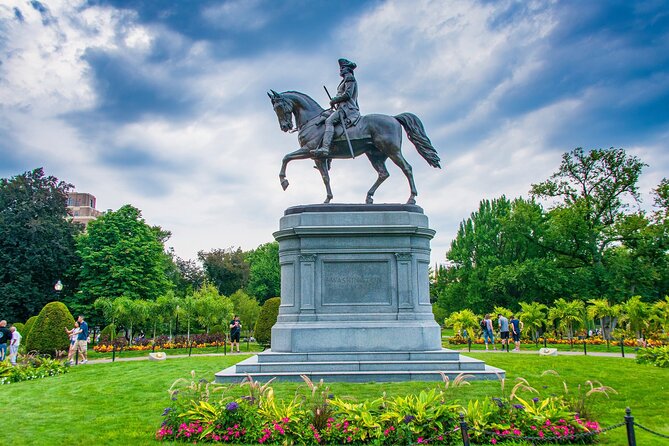
Starting at The Embrace gives this walk an unusual frame. The bronze sculpture on Boston Common was unveiled in 2023 and draws on a photograph of Dr. Martin Luther King Jr. and Coretta Scott King embracing after his 1964 Nobel Peace Prize. Its focus is their intertwined arms, a fitting reminder that Boston’s story includes struggles for justice beyond the Revolution.
You have about five minutes at the sculpture, so think of this as a brief introduction rather than a long stop. It sets a modern note before the route turns toward older streets and landmarks. The sculpture is free to view, and the starting point is 139 Tremont Street.
From there, the route takes in Boston Common and Beacon Hill before heading toward the city’s Revolutionary-era sites. That order matters: you get a sense of the city as a lived-in place, not just a sequence of famous names on plaques.
Beacon Hill’s cobbles and the Common’s open space

Beacon Hill is the neighborhood stop for brick Federal-style homes, gas lamps, and cobbled streets. Acorn Street is among its best-known lanes, and the area’s compact streets offer a sharp contrast to the open lawns of the Common. The scheduled visit is about 15 minutes, enough for a short look and a few photos, not a full neighborhood wander.
I like that Beacon Hill brings the route down to street level. You can notice the architecture and the scale of the old lanes while the guide explains how this part of Boston fits into the wider story. Keep in mind that the tour moves on; save a longer stroll, a café stop, or a shop visit for another time if those are priorities.
Boston Common gets another 15-minute stop. Established in 1634, it is the oldest public park in the United States, and its paths and open green space make a calm pause in the middle of the city. It is also the setting for The Embrace, so you see the park first through a contemporary memorial and then as a historic civic space.
The Common is a useful place to catch your breath and get oriented. The short visit will not cover every corner, and seasonal events or activities may shape what you see on the day. Still, the contrast between parkland and dense downtown streets helps explain why the Common remains central to Boston.
More Freedom Trail tours around Boston:
- Boston: Freedom Trail History Small Group Walking Tour
★ 5.0 · 6,450 reviews - Boston Freedom Trail Walking Tour with Costumed Guide
★ 4.5 · 2,531 reviews - Boston Food & History: Pizza, North End & Freedom Trail
★ 5.0 · 1,772 reviews
The State House and Park Street Church
The Massachusetts State House sits on Beacon Hill, marked by its golden dome. The building is an active symbol of state government as well as a landmark with a place in Massachusetts political history. The walk allows about 15 minutes here, including time to take in the exterior and grounds.
Guided tours of the State House are available, but this tour information does not promise an interior visit. If seeing the inside is important to you, check separately rather than assuming the group will enter. On a two-hour walk, even an exterior stop gives you a chance to appreciate the building’s position above the Common and its distinctive dome.
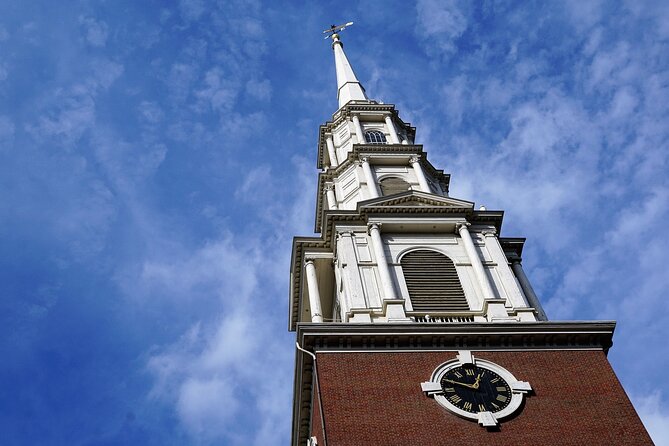
A five-minute stop at Park Street Church follows. Built in 1809, the church is known for its tall white steeple and its role in Boston’s religious and social life. The brief visit is best understood as a look at the building and its place in the neighborhood, rather than time for an extended interior visit.
This stretch of the route shifts the focus from government to religious and civic life. That variety is useful if you want more than a Revolution-only account of Boston. The short timing, though, means you should not expect a detailed visit to every site.
Two burying grounds, two windows into early Boston
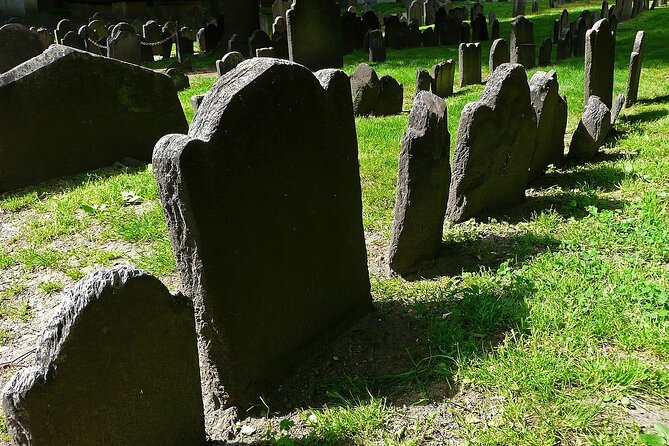
King’s Chapel Burying Ground is described as Boston’s oldest cemetery, dating to 1630. Beside King’s Chapel, it holds the graves of early settlers, including John Winthrop. The planned 15-minute stop gives you time to look at the historic stones and take in the cemetery’s quiet atmosphere.
The burial ground is a sobering counterpoint to the more formal landmarks. Gravestones put individual lives beside the broad political events that shape the usual account of the Revolution. You are also visiting a place with its own story, not merely passing another picturesque old building.
Granary Burying Ground, dating to 1660, is another 15-minute stop. Its best-known names include Paul Revere, Samuel Adams, and John Hancock. The cemetery’s proximity to Boston Common makes it easy to understand why it belongs on a compact downtown history route.
These two cemetery visits are among the walk’s most useful stops if you want the people behind the famous names to feel more real. Look closely at the dates and inscriptions, but remember that the group will keep moving. If you want to linger, take photographs, or read every marker, plan to return on your own.
The Old State House and the road to Faneuil Hall
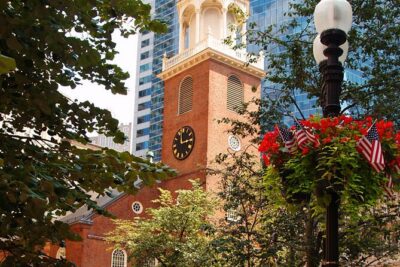
The Old State House, built in 1713, is one of the route’s most direct links to the American Revolution. It was the site of important events, including the reading of the Declaration of Independence. You have about five minutes here, so the stop is a quick introduction to the building’s role and colonial architecture.
The Old State House has exhibits on early American history, but an interior visit is not specified as part of this tour. The short stop is therefore useful for orientation and context, rather than a substitute for time inside the museum. If its exhibits are high on your list, leave room in your day to visit separately.
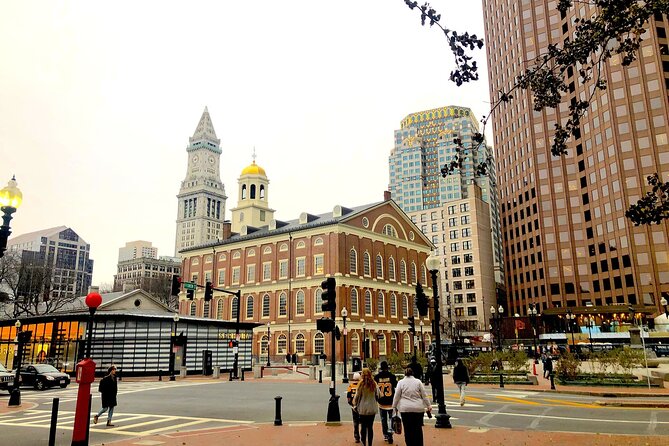
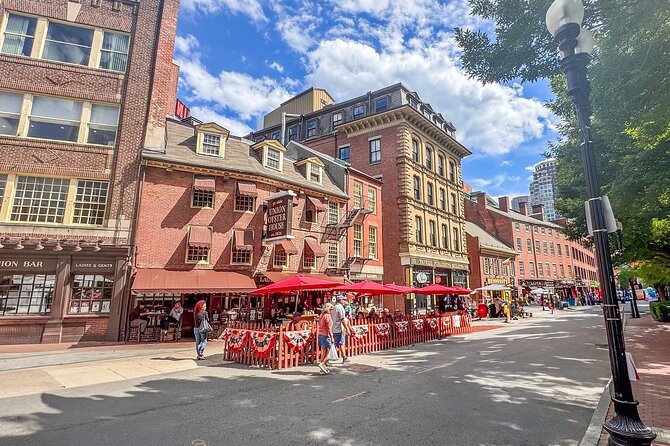
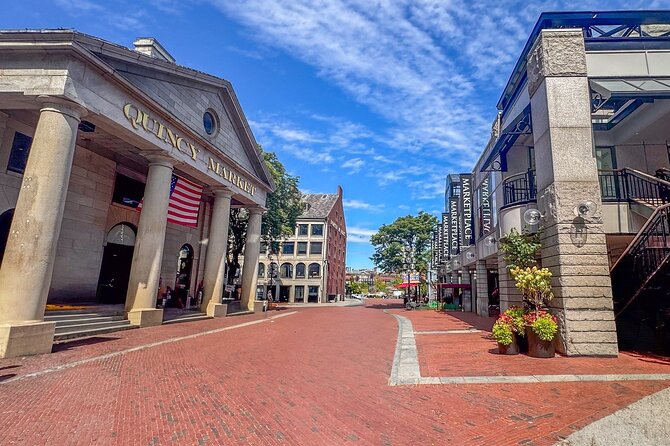
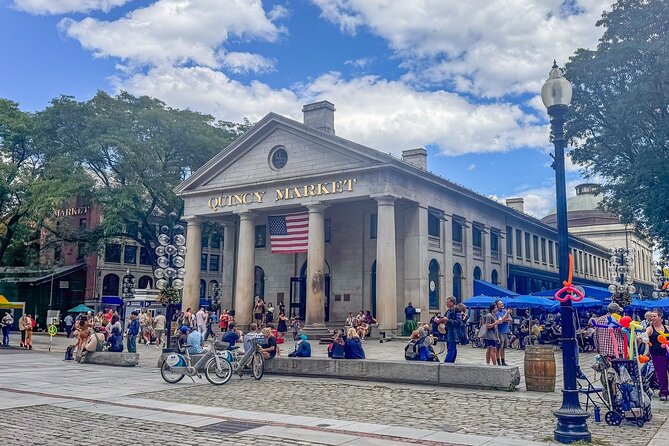
Faneuil Hall is the final historic landmark, often called the Cradle of Liberty. Built in 1742, it was a site for protests against British rule and now houses a marketplace and museum. The tour ends at Faneuil Hall Marketplace, so you finish where Boston’s political past meets its present-day shops and food stalls.
Quincy Market is next to Faneuil Hall and offers food vendors, shops, and street performers. It is a natural place to pause after the walk, grab a meal or snack, and decide what to explore next. No set visit time is provided for Faneuil Hall or Quincy Market, so ask the guide how the final portion is handled if you need to plan a firm departure.
More history tours around Boston:
- Tour of Historic Fenway Park, America’s Most Beloved Ballpark
★ 4.5 · 3,013 reviews - The Full Revolutionary Story Epic Small Group Boston Walking Tour
★ 5.0 · 2,356 reviews - Boston: City Cruises Historical Sightseeing Cruise
★ 4.6 · 1,771 reviews - Boston’s Freedom Trail: A Revolutionary Walking Tour
★ 4.9 · 1,748 reviews
What the two-hour format gives you
The tour lasts about two hours and covers a long list of sites, from The Embrace to Faneuil Hall. Several stops have set windows of five to 15 minutes, which makes this a guided overview rather than an in-depth visit at each location. You trade leisurely exploration for a clear route and a connected account of the city.
That is where a guide can make the price worthwhile. A first visit to Boston can feel like a pile of names, dates, and plaques. Behind-the-scenes details help link the places together and give you a better sense of what happened where. One particularly positive account of the walk praised this kind of context and found the guide made the history interesting.
The group is limited to 10 people, a practical advantage on narrow streets and around busy landmarks. A smaller group can make it easier to hear the guide and ask questions than a large crowd. The tour is offered in English, and no individual guide names are provided.
The walk costs $45 per person. The listed stops are free to visit, but that does not mean every museum or building interior is included. At this price, the main value is the guide, the small-group format, and the efficient connection between historic sites. If you already know Boston well and prefer to explore at your own pace, you may get more from a map and independent visits.
Practical details before you book
The meeting point is The Embrace at 139 Tremont Street, and the walk ends at Faneuil Hall Marketplace, Boston, MA 02109. The one-way route is handy if you want to continue exploring downtown at the finish. You receive a mobile ticket, and confirmation is provided at booking.
The tour is listed as suitable for most people, allows service animals, and is near public transportation. No special physical requirements are specified, but it is a walking tour with multiple outdoor stops, so wear shoes you can comfortably walk in. The available information does not spell out the route’s surface conditions or weather arrangements.
On average, bookings are made 58 days ahead. That is useful context if you are planning a trip, but it is an average rather than a rule; check the date you want. Free cancellation is available until 24 hours before the start time. Within 24 hours, the payment is not refunded and changes are not accepted.
Who should take this Boston walk?
This route suits a first-time visitor who wants a guided orientation to central Boston, especially someone who enjoys connecting streets, buildings, and burial grounds to larger events. It also works well if you value a small group and want a guide to add human detail rather than simply point out landmarks.
It is less suited to anyone hoping to spend a long time inside museums or explore Beacon Hill at a slow pace. The tour covers a lot in two hours, and the final stops at Faneuil Hall and Quincy Market are not assigned specific durations. Treat it as a strong introduction, then return to the places that catch your interest.
At $45, I would book it if you want a compact, guided introduction and appreciate a guide who can supply stories beyond the basic dates. If your priority is entering the Old State House, touring the State House, or lingering in the cemeteries, plan extra time on your own. The best reason to go is the combination of a small group, a well-connected route, and a guide who can make Boston’s landmarks speak to one another.
FAQ
How long is Boston’s Revolutionary Path?
The tour lasts approximately two hours.
What is the price?
The listed price is $45 per person.
Where does the tour begin and end?
It begins at The Embrace, 139 Tremont Street, Boston, and ends at Faneuil Hall Marketplace.
How large is the group?
The tour has a maximum group size of 10 people.
What language is the tour offered in?
The tour is offered in English.
Is an admission ticket included?
A mobile ticket is provided, and the listed stops are free to visit. The tour information does not specify admission to museum or building interiors.
Can I cancel for a refund?
You can cancel at least 24 hours before the start time for a full refund. Cancellations made less than 24 hours before the start time are not refunded.
Just added around Boston
- Boston’s Freedom Trail: A Self-Guided Tour of All 16 Sites★ 5.0 · 14 reviews
- Boston Self-Guided Audio Tour Bundle: Freedom Trail & More★ 4.5 · 5 reviews
- Boston’s Freedom Trail: A Self-Guided Audio Tour★ 4.0 · 18 reviews
- Private Walking tour of Boston’s Freedom Trail and more!★ 5.0 · 29 reviews
- Tour-in-Four — A Private four hour walking & driving city tour★ 5.0 · 32 reviews
- Washington D.C. Cherry Blossom,Baltimore 3-Day Tour from Boston★ 4.5 · 7 reviews
- Freedom Trail Experience★ 5.0 · 8 reviews
- Tour de Cambridge Guided Bicycle Tour★ 5.0 · 34 reviews
Freedom Trail Tours, compared.

Freedom Trail History Small Group Walking Tour
Read our review →
Boston Freedom Trail Walking Tour with Costumed Guide
Read our review →
Boston Food & History: Pizza, North End & Freedom Trail
Read our review →
Boston’s Freedom Trail: A Revolutionary Walking Tour
Read our review →
Boston Freedom Trail History Pub Crawl Small-Group Tour
Read our review →
Entire Freedom Trail Walking Tour: Includes Bunker Hill and USS Constitution
Read our review →Browse the lists this tour appears in