
Reviewed · FREEDOM TRAIL TOURS
Entire Freedom Trail Walking Tour: Includes Bunker Hill and USS Constitution
Boston’s Revolution story makes more sense when you follow it on foot, from the Massachusetts State House to the USS Constitution in Charlestown. I like this tour’s full-trail route, and I like that guides such as Mark connect familiar names to lesser-known people and places, with humor and clear explanations along the way.
The trade-off is time on your feet: this is about four hours of walking, not a quick sampler. The route is roughly 2.8 miles, and the many stops mean you’ll be listening and moving for much of the morning. Wear comfortable shoes and be ready for a history-heavy outing.
- A start-to-finish trail walk: Cover the full Freedom Trail, including Bunker Hill and the USS Constitution.
- History with connections: Hear how events and people fit together, not just a list of dates and landmarks.
- A small group: The tour is capped at 16 people, which helps keep questions and conversation manageable.
- Fourteen planned stops: Expect a mix of churches, burial grounds, historic homes, public spaces, and Revolutionary sites.
- Admission is separate: The walking tour does not include entry to interiors, so plan on seeing some places from outside.
A four-hour walk from Boston Common to Charlestown
The route begins at Beacon Street and Park Street, near Boston Common, at 10:00 a.m. It follows the Freedom Trail through central Boston and across to Charlestown, ending at the USS Constitution. The full trail is about 2.8 miles, but the distance alone doesn’t tell the whole story: you’ll stop repeatedly to hear about the people, political arguments, and turning points tied to each place.
I see the length as the tour’s main advantage and its main challenge. A short walk can show you the red-brick route, but a four-hour outing gives the guide time to explain why the sites matter and how one event led to another. On the other hand, you should expect a long morning with plenty of standing as well as walking.
The group limit is 16. That is small enough to make it easier to hear the guide and ask questions, while still large enough to create a shared walk through the city. Past tours have praised the guide’s ability to keep a steady pace, answer questions, and manage the group around busy streets. Even so, bring water and wear shoes you trust.
The State House and the early trail stops
At the Massachusetts State House, the guide introduces the current seat of state government and the work of architect Charles Bulfinch, an important early figure in American architecture. The stop is brief, about ten minutes, so think of it as an outdoor orientation rather than a building tour. Admission to interiors is not included.
A few minutes away, Park Street Church offers another compact stop. Its history connects to the abolition movement, and the church was once known as Brimstone Corner for its fiery sermons and a surprising use of its cellar. The name gives the guide an opening to discuss the role of religion and public speech in Boston’s civic life.
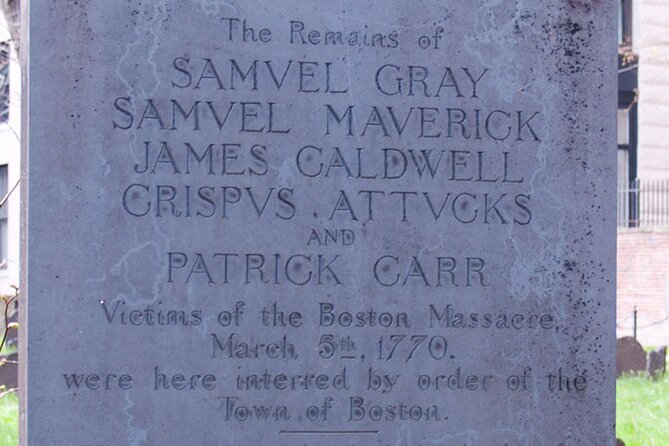
At Granary Burying Ground, the Revolution’s well-known names are no longer just names on a page. Samuel Adams, Paul Revere, John Hancock, and victims of the Boston Massacre are buried here. A short introduction to their roles can help you place the figures in the story before you reach the political sites where their world took shape.
The route then reaches King’s Chapel, built in 1749. Its presence points to an earlier clash over religious authority and the place of the Anglican Church in a Puritan city. The visit is brief, and admission to the interior is not included, but the stop helps broaden the tour beyond the Revolution’s most famous battles.
More Freedom Trail tours around Boston:
- Boston: Freedom Trail History Small Group Walking Tour
★ 5.0 · 6,450 reviews - Boston Freedom Trail Walking Tour with Costumed Guide
★ 4.5 · 2,531 reviews - Boston Food & History: Pizza, North End & Freedom Trail
★ 5.0 · 1,772 reviews
Meeting halls, public arguments, and the road to rebellion
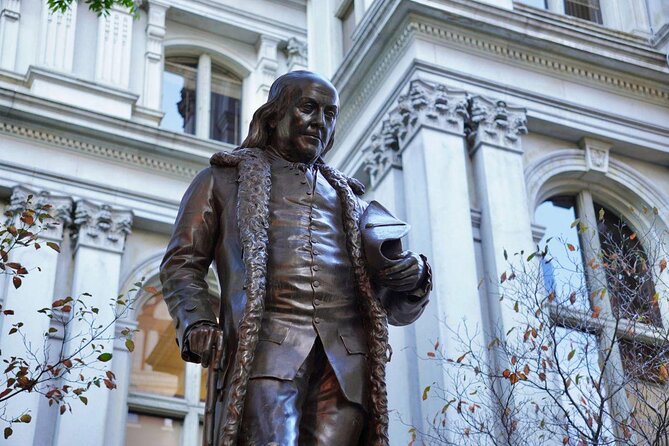
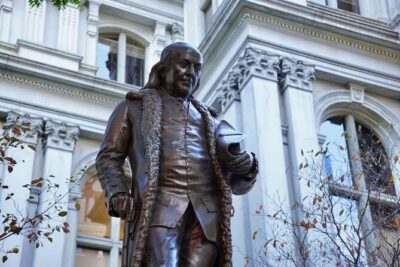
At Old City Hall, you’ll see a statue of Benjamin Franklin and a marker connected to the colony’s oldest still-operating school. It is a reminder that Boston’s story is not only about military conflict. Education, civic life, and public memory also shaped the city.
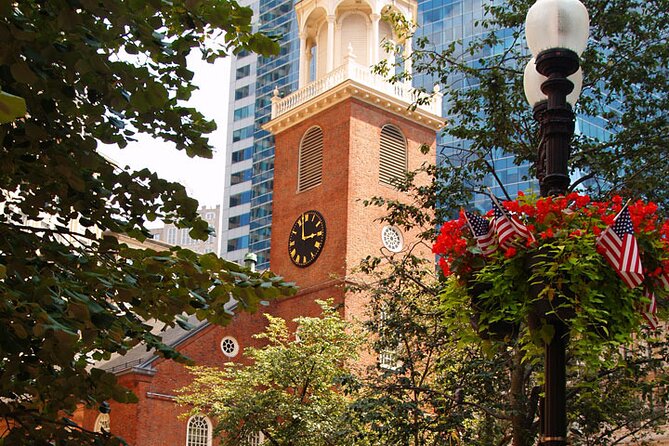
The next stops trace how political debate could turn into direct action. Old South Meeting House was a major gathering place, and it was here that Samuel Adams helped set the Boston Tea Party in motion. The building’s importance is best understood as part of a wider culture of meetings, sermons, and public argument. Admission to the interior is not included.
At the Old State House, the guide turns to the British colonial government and growing disputes over rights. The site is tied both to a 1761 court case involving colonial rights and to the 1770 Boston Massacre. The tour’s framing invites you to look beyond the familiar version of that event and consider how the facts were argued and used.
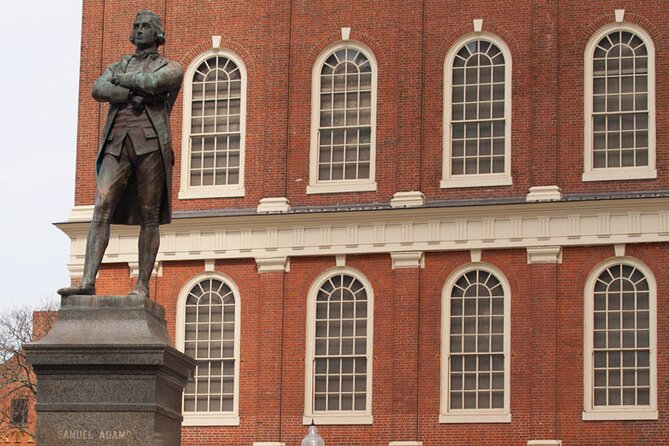
Faneuil Hall Marketplace continues the story of public speech. Samuel Adams spoke here against taxation without representation, and Frederick Douglass later addressed audiences in the hall as an escaped slave and abolitionist. That later chapter is valuable: it shows how the building’s role in debate continued beyond the Revolution.
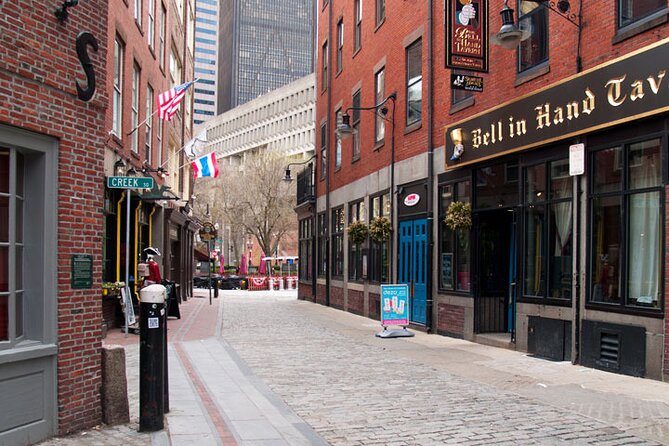
The Blackstone Block adds smaller, less obvious details to the walk. You’ll hear about the Massachusetts Spy newspaper, a tavern associated with the Revolution’s headquarters, and the home of Ebenezer Hancock, John Hancock’s brother. French money supporting the Revolution was stored at Ebenezer’s house, a practical detail that makes the financial side of the conflict easier to picture.
Paul Revere’s home and the signal from Old North Church
The Paul Revere House is one of Boston’s oldest surviving homes. Revere bought the 1680 house in 1770, and his family life unfolded there amid the political tensions that later made him famous. The stop offers a useful counterweight to the midnight ride story: Revere was also a working Boston resident and father of sixteen children with two wives. Admission to the interior is not included.
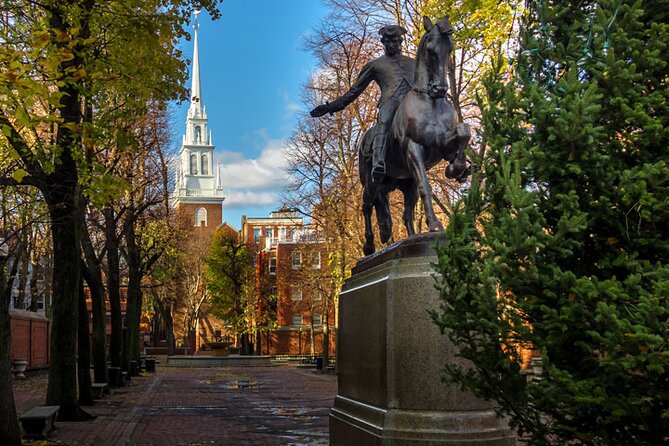
At Old North Church, you’ll hear how the church’s lantern signal warned Patriots in Charlestown about the British movement toward Lexington and Concord. This is one of the trail’s best-known moments, but the setting gives it geographic meaning: the signal crossed the narrow water between Boston and Charlestown. The tour allows about ten minutes here, with interior admission separate.
From there, Copp’s Hill Burying Ground helps explain the ground between the city and the Battle of Bunker Hill. The guide points out the geography and a grave marker with a story of its own. This is a quieter stop, but it prepares you for the change in scale from city politics to battlefield.
Bunker Hill and Old Ironsides

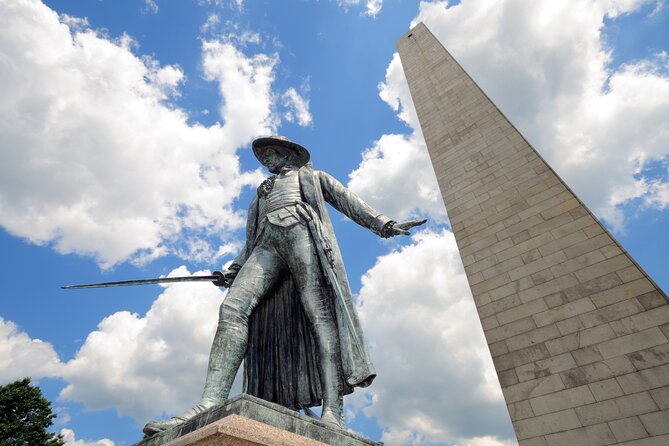
At the Bunker Hill Monument, the guide explains the battle fought on Breed’s Hill. The Patriots lost the battle, but British casualties were roughly triple those of the Patriot force. That contrast helps explain why the fight mattered even in defeat: it showed the British that the colonial forces could inflict a serious cost.
The monument is listed as a free stop, but the walking tour does not include admission to interiors. The provided schedule allows about ten minutes here, so expect a concise historical explanation rather than an extended visit. If climbing the monument or exploring it at length matters to you, check separately what access is available on your date.
The final stop is the USS Constitution, known as Old Ironsides. The ship served the U.S. Navy in American and foreign waters and is the world’s oldest commissioned warship. The tour ends at the vessel in the Charlestown Navy Yard, giving the walk a strong finish: you move from arguments over colonial rights to the young nation’s military history.
The tour’s end point is also worth planning around. You finish in Charlestown, not back at the starting point near Boston Common. The tour information does not include return transport, so consider how you want to continue your day before setting off. Admission to interiors is not included, and the tour does not promise an onboard visit.
More walking tours around Boston:
- Harvard University Campus Guided Walking Tour
★ 4.5 · 3,632 reviews - The Full Revolutionary Story Epic Small Group Boston Walking Tour
★ 5.0 · 2,356 reviews - Boston’s Freedom Trail: A Revolutionary Walking Tour
★ 4.9 · 1,748 reviews - Boston: Freedom Trail History Small Group Walking Tour
★ 4.9 · 1,590 reviews
What the $79 price includes, and what it doesn’t
At $79 per person, you’re paying for a four-hour guided walk across the whole trail, not for entry to every historic building. The guide’s narration is the central value: it supplies context at each stop and connects events that can otherwise feel scattered across a city map. Gratuity is included, and the guide does not expect or accept tips.
The price makes the most sense if you want a clear, connected account of Boston’s Revolution and prefer a guide to navigating the route alone. The small group size and full-trail coverage add value, especially if this is your first time in Boston or you have limited time to see the key sites. If you mainly want to enter buildings or spend a long time at each one, you may prefer to explore some places separately after the walk.
A useful feature of the guide’s approach is the attention to people who can get lost in the standard story, including women’s contributions and lesser-known characters. The narration is often described as detailed but approachable, with humor rather than theatrical reenactment. That balance should suit you if you want substance without a lecture that feels like homework.
Who should take this walk
This is a strong choice for history fans who want the entire trail in one outing. It also works well for families with teenagers who can handle a long walk and enjoy a sustained history lesson. The guide’s storytelling and occasional humor help keep the pace lively, but the subject matter is substantial.
Younger children may find four hours of stops and narration too much unless they already love history. The guide has advised that children under 12 should be especially interested in the subject to get the most from the experience. That’s sensible advice: this is not a quick, hands-on activity designed around short attention spans.
You don’t need to be an athlete, but you should be comfortable walking for several hours. The route is described as mostly flat and at a manageable pace, including for older participants, though some walkers count close to 10,000 steps. That estimate varies by stride and movement around stops, but it gives you a fair idea of the day’s effort.
The tour is offered in English, confirmation is received at booking, and service animals are allowed. It runs in good weather; if poor weather cancels the tour, you’ll be offered another date or a full refund. You can cancel for a full refund up to 24 hours before the start time. Bookings are often made well ahead, averaging about 55 days, so don’t assume a preferred date will remain open.
Should you book the full Freedom Trail tour?
Book it if you want Boston’s Revolutionary story told as one connected walk, and if you’re happy to spend four hours outdoors with a guide. The strongest reasons are the complete route, the inclusion of Bunker Hill and the USS Constitution, and the way a good guide can link famous events to the less familiar people and places around them.
Skip it if you want a short overview, dislike extended walking, or expect admission to historic interiors to be part of the price. For the right visitor, though, this is an efficient way to understand why Boston mattered to the Revolution and to finish the trail with its story still fresh.
FAQ
How long is the tour?
The tour lasts about four hours.
How far do you walk?
The full Freedom Trail route is about 2.8 miles, or 4 kilometers. The walk includes multiple stops.
Where does the tour start and end?
It starts at Beacon Street and Park Street in Boston and ends at the USS Constitution in Charlestown.
What time does the tour start?
The listed start time is 10:00 a.m.
Is admission to historic buildings included?
No. Admission to interiors is not included. The tour visits the sites, but you should not assume that you’ll enter every building.
Is the USS Constitution included?
Yes. It is the final stop, and the tour concludes at the ship. Admission to interiors is not included.
How large is the group?
The maximum group size is 16 people.
Is a guide gratuity expected?
No. Guide gratuity is included, and the guide does not expect or accept tips.
What happens if bad weather cancels the tour?
You’ll be offered a different date or a full refund.
Just added around Boston
- Boston’s Freedom Trail: A Self-Guided Tour of All 16 Sites★ 5.0 · 14 reviews
- Boston’s Freedom Trail: A Self-Guided Audio Tour★ 4.0 · 18 reviews
- Private Walking tour of Boston’s Freedom Trail and more!★ 5.0 · 29 reviews
- Boston Self-Guided Audio Tour Bundle: Freedom Trail & More★ 4.5 · 5 reviews
- Tour-in-Four — A Private four hour walking & driving city tour★ 5.0 · 32 reviews
- Washington D.C. Cherry Blossom,Baltimore 3-Day Tour from Boston★ 4.5 · 7 reviews
- Freedom Trail Experience★ 5.0 · 8 reviews
- Tour de Cambridge Guided Bicycle Tour★ 5.0 · 34 reviews
Freedom Trail Tours, compared.

Freedom Trail History Small Group Walking Tour
Read our review →
Boston Freedom Trail Walking Tour with Costumed Guide
Read our review →
Boston Food & History: Pizza, North End & Freedom Trail
Read our review →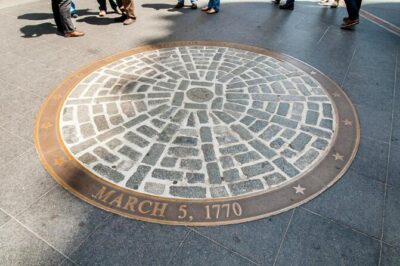
Boston’s Freedom Trail: A Revolutionary Walking Tour
Read our review →
Boston Freedom Trail History Pub Crawl Small-Group Tour
Read our review →
Downtown Freedom Trail, Beacon Hill & Back Bay Walking Tour
Read our review →Browse the lists this tour appears in