
Reviewed · BOSTON HISTORY TOURS
The Full Revolutionary Story Epic Small Group Boston Walking Tour
Boston’s revolutionary story is easier to follow when you see the city in the order events unfolded, rather than simply ticking off landmarks along the Freedom Trail. This three-hour-plus walk starts at City Hall Plaza and finishes by the harbor, connecting familiar sites with the people and conflicts that shaped them.
I like two things here: the guide builds a connected story instead of delivering a string of short site descriptions, and the route includes corners of modern Boston as well as the official trail. Small groups are capped at 15, so you have a better chance to ask questions and keep up with the discussion.
The trade-off is the distance and time on your feet. The walk takes about three to three-and-a-half hours, and the history is aimed at curious adults and older children, not delivered as a children’s show. Comfortable walking shoes and weather-ready layers will make a real difference.
- The route follows the Revolution’s sequence: The guide links key events in chronological order, rather than simply walking the Freedom Trail from one end to the other.
- You see more than the red-brick path: Stops include downtown squares, the Greenway, the North End, and Boston Harbor.
- The group is limited to 15: That keeps the walk smaller than a large coach-style outing and gives you room to interact.
- The guide uses visual aids: Maps, character badges, and small models, including Lego soldiers for the Battle of Bunker Hill, help make the story easier to picture.
- The finish is practical: Lewis Wharf is near North End restaurants, public restrooms, public transportation, and the Aquarium T stop.
- It costs $55 per person: That is a reasonable price for a guided walk lasting up to three and a half hours, especially if you want context rather than a self-guided checklist.
Start at City Hall Plaza, then head into Boston’s past
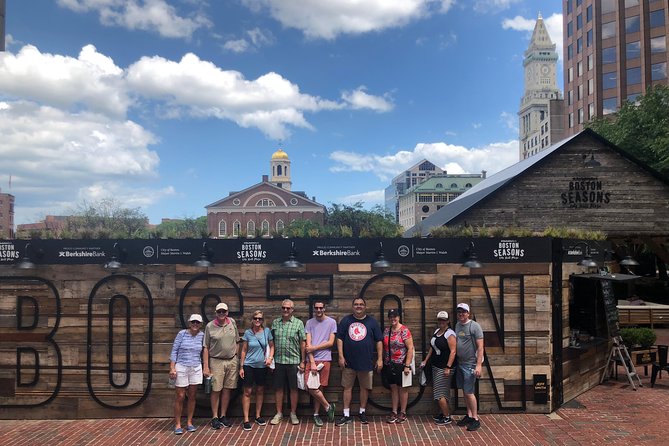
Meet your guide at City Hall Plaza, between Five Iron Golf and City Hall, near the seasonal beer garden and the large Boston sign. Faneuil Hall makes a handy backdrop for a first photo. The opening stop is brief, but it sets the tone: Boston’s old story sits right inside a busy modern city.
You pass Boston City Hall, known for its distinctive architecture, before reaching King’s Chapel Burying Ground. Here, the guide introduces the first settlers of Massachusetts Bay and the Puritan culture they built. This early stop matters because it gives the Revolution a longer backstory. The colonies did not spring into being on the eve of rebellion; their religious, political, and social traditions were already shaping how people argued about authority.
The route also passes Boston’s first Anglican church and Brimstone Corner, associated with fiery sermons and an early public anti-slavery address by William Lloyd Garrison in 1829. These stops broaden the story beyond the famous founders. Boston’s public life included religious disagreements and debates over human freedom long before independence was secured.
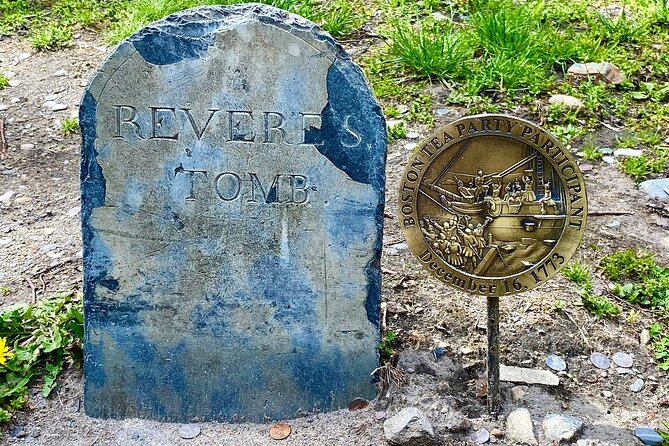
At Granary Burying Ground, you visit the graves of Paul Revere, John Hancock, and Samuel Adams. The guide uses the site to ask who the Sons of Liberty were and what they actually did. That distinction is useful: the names are familiar, but it takes some explanation to connect individual figures, local protest, and the larger conflict with Britain.
Follow the Freedom Trail by events, not just by geography
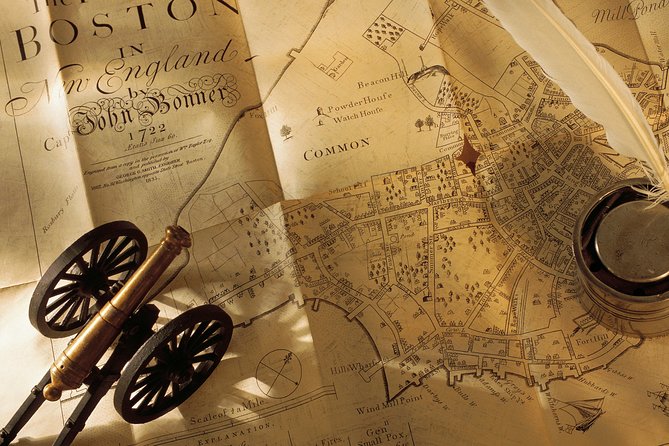
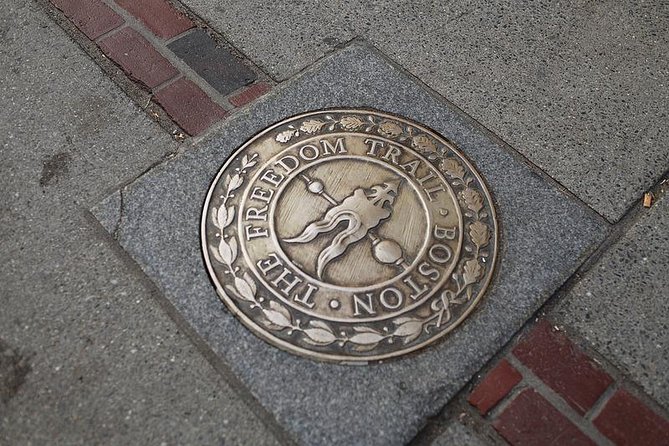
The Freedom Trail is a brick path joining 16 historic landmarks. This tour uses many of its major sites, but its organizing idea is chronology. In practice, that means the guide can explain how one argument led to another instead of treating every landmark as a separate stop.
At the Old City Hall, the conversation turns to democracy and its challenges. The stop is short, but it provides a chance to consider that self-government was an aspiration with real obstacles, not a tidy principle everyone agreed on. Nearby, a statue of Benjamin Franklin introduces Boston’s first public school and one of its most famous pupils.
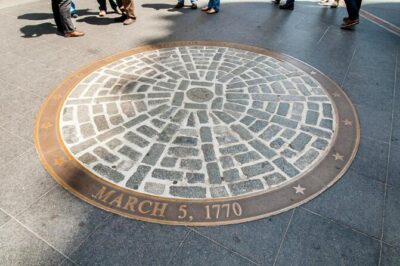
The Old State House brings the political dispute into sharper focus. It served as a center of Massachusetts politics and was the setting for debates about British power and colonial rights. Outside, at the Boston Massacre site, the guide examines the soldiers, townspeople, Loyalists, and Patriot leaders caught up in the rising tension. The point is not just to memorize the date of an event. It is to understand how different groups interpreted the same confrontation.
The group also passes a former publishing house connected with American writers including Ralph Waldo Emerson, Henry Wadsworth Longfellow, and Nathaniel Hawthorne. That is a reminder that Boston’s importance was not limited to the road to independence. Its history continued through education, publishing, and civic life.
At Old South Meeting House, the story reaches the Boston Tea Party. This is where protest moved toward open revolt. The guide links the gathering to the choices that followed, making this one of the tour’s key turning points. If you know the broad outline already, expect the value here to come from the people and pressures around the event, rather than a basic recital of dates.
More history tours around Boston:
- Boston: Freedom Trail History Small Group Walking Tour
★ 5.0 · 6,450 reviews - Tour of Historic Fenway Park, America’s Most Beloved Ballpark
★ 4.5 · 3,013 reviews - Boston Food & History: Pizza, North End & Freedom Trail
★ 5.0 · 1,772 reviews
See the present-day city between historic stops
The walk does not treat modern Boston as scenery to hurry past. At Post Office Square and in the Financial District, the guide connects the old city to present-day finance, education, and health care. Boston’s historic center is still a working city, and that context makes the old buildings feel less like a preserved display and more like part of a living place.
Faneuil Hall is known as the Cradle of Liberty, and the tour uses it to explain how public protest could take on a revolutionary force. There is a built-in break for entering Faneuil Hall and Quincy Market. The latter can be crowded and commercial, and the tour itself flags the risk of tourist traps. Take the break as a chance to get oriented, use the facilities, or grab a quick bite, rather than expecting a quiet historic pause.
From there, the walk crosses the Rose Fitzgerald Kennedy Greenway, a public garden stretching through the city. It offers a change of pace from tight sidewalks and stone buildings. It also helps make the point that Boston has grown and changed around its historic core.
This mix is one of the tour’s better choices. A history walk can become tiring if every stop asks you to imagine a vanished city with no sense of the one around you. Here, the financial district, gardens, food stalls, and harbor help you understand how Boston functions now.
Reach the North End through Paul Revere’s neighborhood
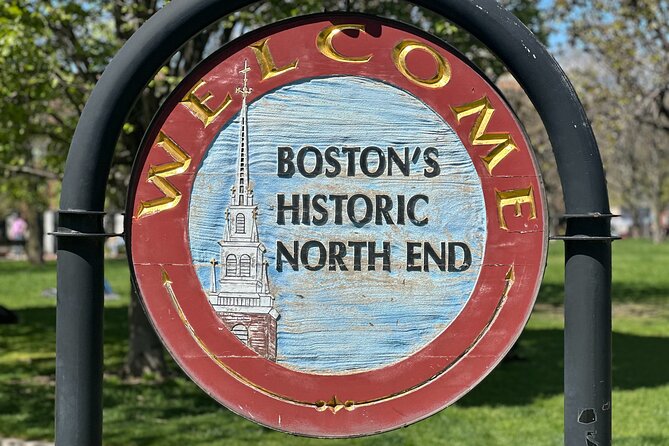
The Paul Revere House sits in one of the city’s oldest squares, in the North End. The guide looks beyond the familiar midnight-ride legend to discuss Revere as a person and his place in the wider story. The neighborhood itself adds useful texture: this is not only a historic district, but also a place known for Italian food, seafood, pizza, and cannoli.
At North Square Park, the guide describes the area’s early residential character. The Paul Revere statue offers a quick photo stop, then the route reaches Old North Church. Its signal lanterns are central to the story of Revere’s ride, the warning to the countryside, and the fighting at Lexington and Concord.
This section is especially effective if the route has already established the political tensions and the Boston Tea Party. The church’s familiar line about lanterns now has a sequence behind it. You can follow the chain from protest to warning to battle, rather than treating the midnight ride as an isolated adventure.
A second burial ground is viewed from outside. The terrace across the street offers views toward Charlestown and Boston Harbor. That pause provides a visual link to the next part of the story and a welcome break from looking down at maps or plaques.
Picture Bunker Hill, then finish by the harbor
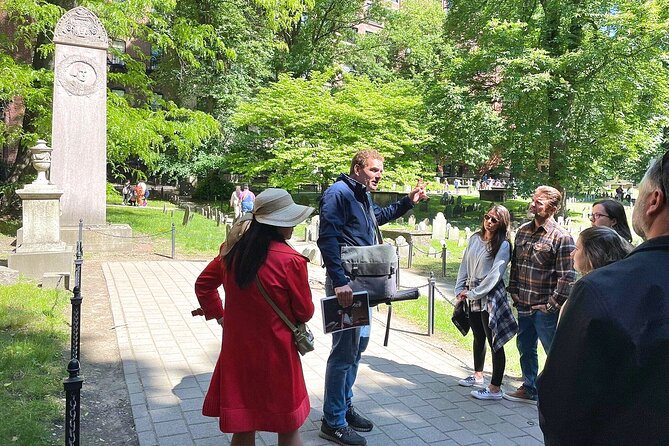
At Bunker Hill Monument, the guide recreates the Battle of Bunker Hill through explanation and visual aids. A small model, such as the Lego soldiers used by guide Tyler, can make troop positions and movement easier to grasp than a spoken account alone. The battle was the largest of the American Revolution, and this is one of the stops where the tour’s teaching style can be particularly useful.
The walk also gives you an overview of USS Constitution, known as Old Ironsides, from across Boston Harbor. It was not part of the Revolution, but the guide explains its later history and offers tips on experiencing it separately. You do not need to confuse it with the Revolutionary story to appreciate why it matters to Boston’s maritime past.
The tour then passes through the North End and reaches the Harborwalk. The waterfront gives you open views of the harbor and city, along with a final part of the Revolution story: the British were ultimately driven out of Boston. The route ends at Lewis Wharf, less than a ten-minute walk from the original meeting point and within walking distance of the Aquarium T stop.
The finish is well chosen. You are in the heart of the North End, close to restaurants and public facilities, so you can turn the end of the tour into lunch or dinner. The guide may also offer restaurant recommendations. Keep in mind that the tour is a walk, not a transport service, and you will need to make your own way back or onward.
More walking tours around Boston:
- Harvard University Campus Guided Walking Tour
★ 4.5 · 3,632 reviews - Boston Freedom Trail Walking Tour with Costumed Guide
★ 4.5 · 2,531 reviews - Boston’s Freedom Trail: A Revolutionary Walking Tour
★ 4.9 · 1,748 reviews - Boston: Freedom Trail History Small Group Walking Tour
★ 4.9 · 1,590 reviews
What the guides and small-group format add

The tour’s strongest feature is the way its guides teach. Guides who have led it include Tyler, Mike, Chris, and Tom. Tyler has a master’s degree in American history and worked as a curriculum coordinator; Mike has advanced history degrees. The tour is presented as a history lesson, not a costume performance or reenactment.
That approach suits people who want substance and interaction. Guides use maps, visual cards, character badges, and models to make events easier to track. They may invite the group to participate, and the small-group cap of 15 helps keep the discussion more personal. You should not assume a particular guide or teaching prop on your date, but the format is built around explanation rather than theatrics.
Families can bring children of any age, provided children are accompanied by an adult. Still, this is not a child-specific version of the story. An engaged eighth grader may follow the material well, but younger children may find three hours of outdoor history a long stretch. Solo visitors and couples can also fit in comfortably, since the walk is designed for a small mixed group.
Is $55 fair value for a three-hour walk?
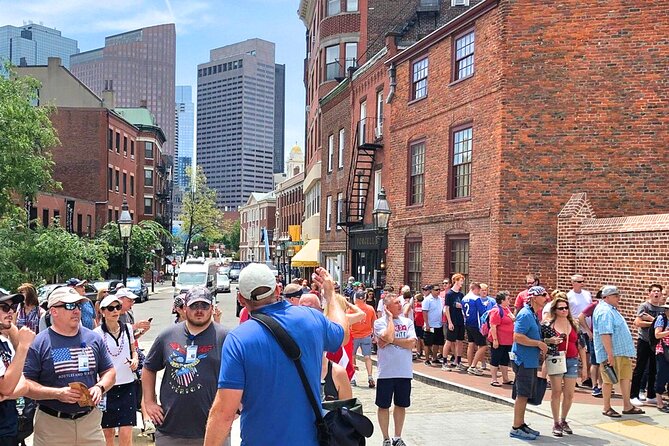
At $55 per person, this is not the cheapest way to see Boston’s historic center. It is, however, a substantial guided experience: roughly three to three-and-a-half hours, a small group, many major Freedom Trail sites, additional city stops, and a route that ends at the waterfront. If you want a connected account of the Revolution, the cost buys interpretation and structure, not just access to the sidewalks.
The main question is whether you want that much history in one sitting. The tour includes many names, events, and places. That density is a plus for history fans, but it can be a lot to take in if you prefer short, light sightseeing stops. The overall route is long enough that good shoes matter, and the walk happens outdoors in changing weather. Some people have completed it in cold, windy, or rainy conditions, but there is no indoor shelter throughout the route.
There is free cancellation up to 24 hours before the start time. The tour can be canceled for poor weather or if the minimum number of participants is not met; in either case, you are offered another date or a full refund. The ticket is mobile and the tour is offered in English.
Should you book the Revolutionary Story Tour?
Book this walk if you want Boston’s landmarks to add up to a story, not just a set of photographs. It is a strong fit for history enthusiasts, first-time visitors who want a grounded introduction, and families with older children who can manage a long outdoor walk. The chronology, visual aids, and North End finish are useful features at a fair price.
Skip it if you have mobility concerns, dislike extended walking, or want a short overview with plenty of indoor time. If you do book, wear comfortable shoes, check the weather, and leave room in your day for the North End after the tour. The finish is a good place to put the guide’s food recommendations to use.
FAQ
How long is the tour?
It lasts approximately three to three-and-a-half hours. The route is a walking tour with many stops.
How much does it cost?
The listed price is $55 per person.
Where does the tour start?
It starts at City Hall Plaza, at 1 City Hall Square, Boston. The meeting area is between Five Iron Golf and City Hall, near the large Boston sign and seasonal beer garden.
Where does the tour end?
It ends at Lewis Wharf in the North End, by Boston Harbor. The end point is less than a ten-minute walk from the starting area and less than a five-minute walk from the Aquarium T stop.
How many people are in the group?
The tour has a maximum of 15 participants.
Is the tour suitable for children?
Children of all ages may attend with an adult, but this is not a children’s version of the history.
Is transportation included?
No. The experience is a walking tour, and transportation is not included.
What happens if the weather is poor?
The experience may be canceled because of poor weather. If that happens, you will be offered a different date or a full refund.
Can I cancel for a refund?
You can cancel for a full refund if you do so at least 24 hours before the start time. Cancellations made later than that are not refunded.
Just added around Boston
- Boston’s Freedom Trail: A Self-Guided Tour of All 16 Sites★ 5.0 · 14 reviews
- Boston’s Freedom Trail: A Self-Guided Audio Tour★ 4.0 · 18 reviews
- Private Walking tour of Boston’s Freedom Trail and more!★ 5.0 · 29 reviews
- Boston Self-Guided Audio Tour Bundle: Freedom Trail & More★ 4.5 · 5 reviews
- Tour-in-Four — A Private four hour walking & driving city tour★ 5.0 · 32 reviews
- Washington D.C. Cherry Blossom,Baltimore 3-Day Tour from Boston★ 4.5 · 7 reviews
- True Crime Tour of Boston★ 4.0 · 17 reviews
- Freedom Trail Experience★ 5.0 · 8 reviews
Boston History Tours, compared.

History and Hauntings of Salem Guided Walking Tour
Read our review →
Freedom Trail History Small Group Walking Tour
Read our review →
Tour of Historic Fenway Park, America’s Most Beloved Ballpark
Read our review →
Boston Food & History: Pizza, North End & Freedom Trail
Read our review →
Boston’s Freedom Trail: A Revolutionary Walking Tour
Read our review →
City Cruises Boston Historic Sightseeing Harbor Cruise
Read our review →
Boston Pizza Lovers Food and History Walking Food Tour
Read our review →Browse the lists this tour appears in