
Reviewed · BOSTON HISTORY TOURS
Boston: Full Revolution Story Epic Small Group Walking Tour
Boston’s Revolution story makes more sense when you follow the events in the order they unfolded, rather than simply ticking off Freedom Trail stops. This 3.5-hour walk links the city’s landmarks into one narrative, from Boston’s early history to the Declaration of Independence, with the Boston Massacre, Tea Party, Lexington and Concord, and Bunker Hill along the way.
I like two things in particular: the group is small, at about 16 people, and guides use maps, pictures, and other visual aids to make complicated events easier to follow. I also like that the route includes both familiar sights and quieter corners beyond the usual trail.
The trade-off is time and effort. You’ll be walking for more than three hours, and the guide moves the story along at a purposeful pace. It suits adults and older children with a real interest in history better than young children looking for a short, light tour.
At a glance

- History told in event order: The route links people, places, and causes into one account rather than treating each landmark as an isolated stop.
- A small group: About 16 people makes it easier to hear, ask questions, and take part in the guide’s storytelling.
- Maps and visual aids: Guides use images and props, and sometimes invite participants to take on historical roles.
- More than the Freedom Trail: The walk ranges through central Boston, the North End, and the Charlestown waterfront.
- A long walk with a hill: The activity takes 210 minutes, with moderate physical effort, one uphill section, and stairs near the end.
- A useful finish in Little Italy: The tour ends near the North End and includes local dining recommendations.
Why the story-first route matters

Boston is full of sites linked to the Revolution, but a sequence of plaques and dates can leave you with a pile of facts and no clear idea of how the crisis grew. This tour aims to connect the dots. You hear about people such as Samuel Adams, John Adams, John Hancock, Paul Revere, and Benjamin Franklin as participants in a changing political struggle, not just names attached to statues.
The route is designed around the history, not simply the familiar line on the Freedom Trail. That means events can be explained in a useful order, with the guide connecting one neighborhood and landmark to the next. If you’re visiting from outside the United States, that structure is especially helpful: you do not need to know the story in advance to follow its causes and consequences.
The guides bring plenty of energy to the subject. Mike, Tyler, Rob, Tom, and Chris are among the guides who have led the walk. Their style can vary, but the format gives them room to explain motives, political tensions, and lesser-known figures, as well as the headline events. The aim is to understand why things happened, not simply memorize when they did.
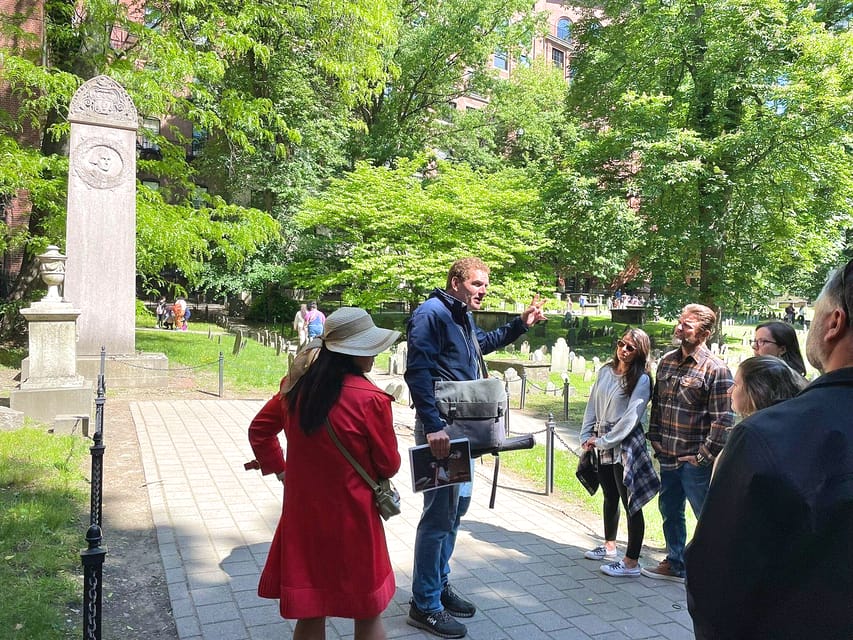
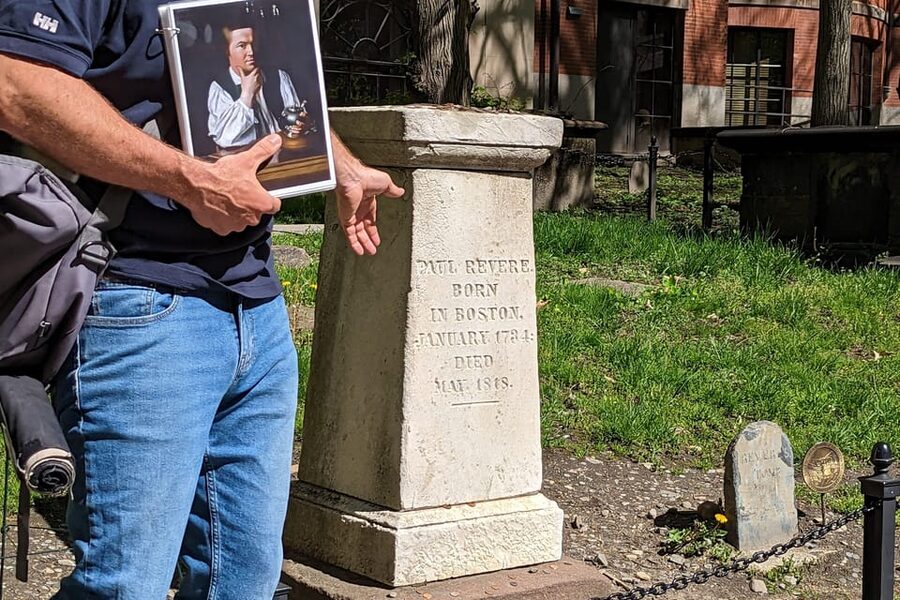
Expect an animated lesson, but not a theatrical one. There are no costumes or staged reenactments. Instead, guides use maps, photographs, diagrams, and props. Some involve participants by assigning them historical roles, a simple device that can make a crowded cast of revolutionary figures easier to keep straight.
More history tours around Boston:
- Boston: Freedom Trail History Small Group Walking Tour
★ 5.0 · 6,450 reviews - Tour of Historic Fenway Park, America’s Most Beloved Ballpark
★ 4.5 · 3,013 reviews - The Full Revolutionary Story Epic Small Group Boston Walking Tour
★ 5.0 · 2,356 reviews
From City Hall Plaza to the old burial grounds
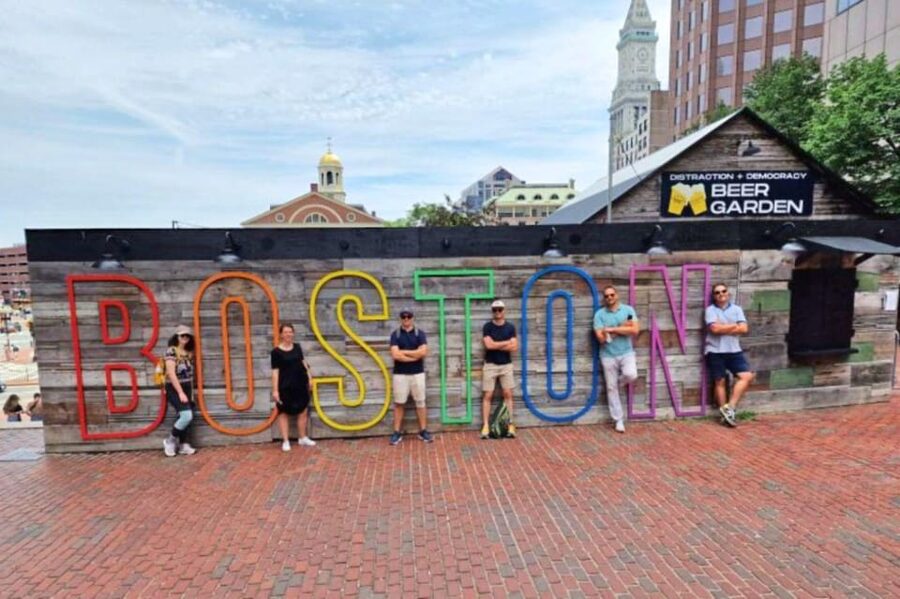
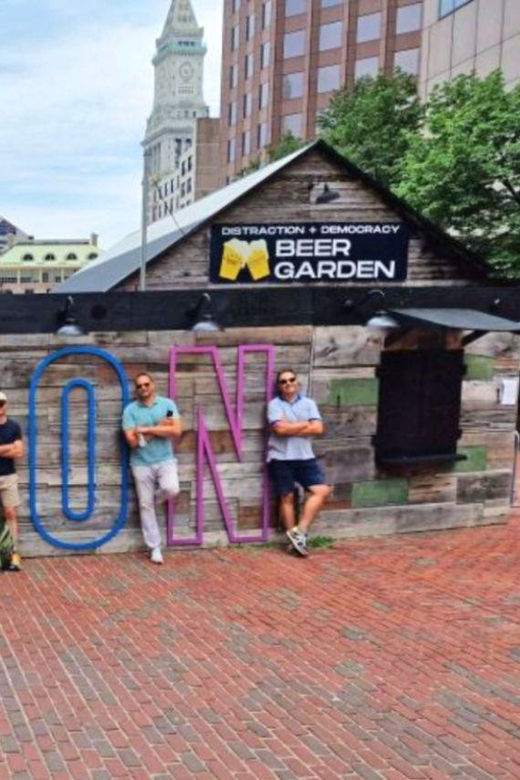
The walk begins at City Hall Plaza, across from Faneuil Hall. Meet in front of Five Iron Golf, near the Bill Russell statue and seasonal beer garden. The Green Line’s Government Center stop and the Orange and Blue Line’s State Street stop are the closest transit options named for the meeting point.
The first stretch introduces the Freedom Trail, but the tour does not stick to a simple point-to-point march. Early stops include King’s Chapel Burying Ground and Granary Burying Ground, where the guide can set the scene of Boston’s colonial past and point out the people who shaped it. Granary is associated with figures including Samuel Adams, John Hancock, and Paul Revere, making it a natural place to connect names with the larger story.
King’s Chapel and Granary are outdoor historic sites, so the visit is about their setting and the stories attached to them. They are compact stops, but they help establish that the Revolution grew out of a real city with generations of civic and religious life behind it.
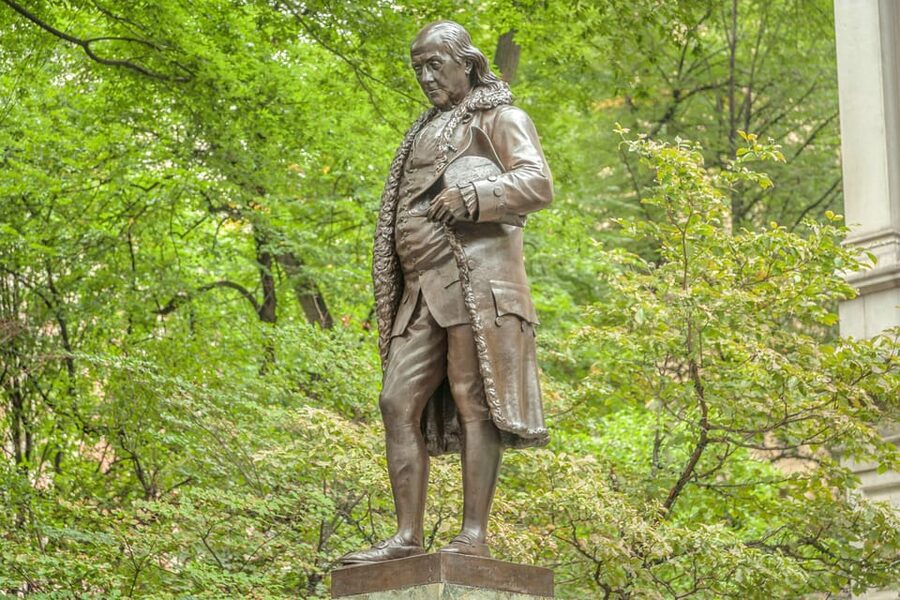
You’ll also pass Park Street Church and visit Old City Hall, followed by the Boston Latin School and Benjamin Franklin statue. These stops widen the frame beyond the familiar revolutionary leaders. Franklin’s early Boston years, for example, help show that the story includes people whose influence later extended well beyond the city.
Old State House and the Boston Massacre
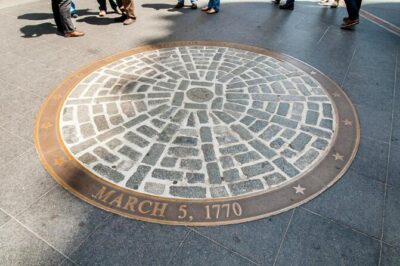
The Old State House is one of the tour’s most important political landmarks. Here the story moves from background to confrontation, with the guide explaining how Boston’s relationship with British rule hardened. Nearby, the Boston Massacre site brings a major event into the street where it happened.
These stops work best when you pay attention to the links between them. The Massacre was not an isolated burst of violence, and the guide’s job is to explain how public feeling, political organizing, and the choices of individuals fed into the crisis. Maps and visuals can help you picture the city and the way people moved through it at the time.
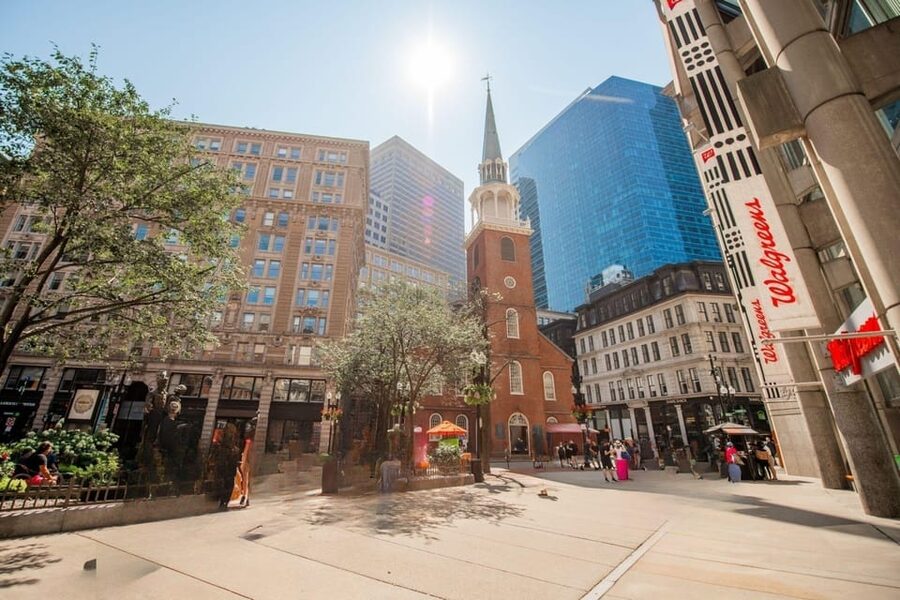
The tour also passes the Old Corner Book Store and visits Old South Meeting House. Old South is closely tied to the meetings that preceded the Boston Tea Party, and it gives the story a place where people gathered, debated, and made decisions. The walk then passes Post Office Square and Liberty Square on the way to Faneuil Hall.
Not every stop is a long visit. A few are brief pass-bys, so you should not expect to go inside every historic building. Faneuil Hall is included as a visit, with entry when it is open. The distinction matters if you’re hoping for an interior tour at each landmark: the main experience is a guided outdoor walk, not a series of museum admissions.
Faneuil Hall, Quincy Market, and a short pause

Faneuil Hall is one of Boston’s most recognizable civic landmarks, and it helps explain the city’s tradition of public debate. The guide uses the stop to tie the meeting places of the Revolution to the political choices that followed.
A 15-minute break at Quincy Market gives you a chance to use the restroom, stretch, or grab a quick bite. It is a short pause rather than a full meal stop, so have a plan if you know you’ll need more time to eat. The market can also be busy, and a tightly timed break is best treated as a practical breather, not a chance to explore every shop.
From there, the route passes the Rose Kennedy Greenway and heads toward the North End. This transition is part of the appeal: the city changes around you, and the historic narrative continues through streets that are still lived in and used, rather than ending at a tidy row of monuments.
More walking tours around Boston:
- Harvard University Campus Guided Walking Tour
★ 4.5 · 3,632 reviews - Boston Freedom Trail Walking Tour with Costumed Guide
★ 4.5 · 2,531 reviews - Boston’s Freedom Trail: A Revolutionary Walking Tour
★ 4.9 · 1,748 reviews - Boston: Freedom Trail History Small Group Walking Tour
★ 4.9 · 1,590 reviews
Paul Revere’s North End and the Old North Church
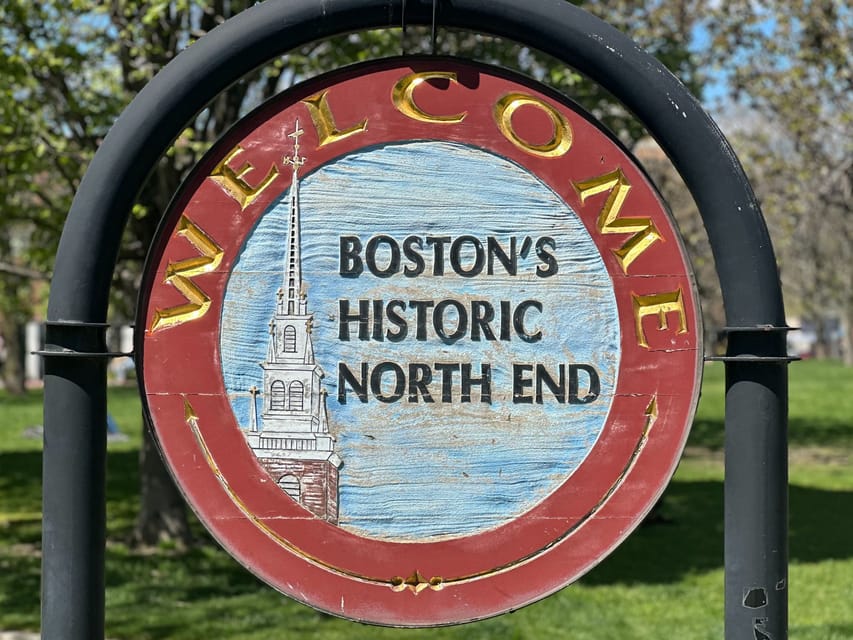
The North End is one of the strongest sections of the walk for atmosphere. You’ll visit the Paul Revere House, walk through the neighborhood, and stop at Paul Revere Mall before reaching Old North Church. The guide connects Revere’s story to the broader network of people and events that carried Boston toward open rebellion.
Old North Church is best known for its role in the signal before the midnight ride. Here, the maps and explanations can help you understand the route and the practical details behind a story that is often reduced to a slogan. The walk also includes Copp’s Hill, where the route offers scenic views and a chance to place the North End in relation to the harbor and Charlestown.
The finish in the North End is a real advantage. The guide shares local food recommendations, so you can stay for a meal after the walk rather than having to retrace your steps to find somewhere to eat. Treat those tips as a starting point, then choose according to your appetite and how much time you have.
Across the harbor toward Bunker Hill
The walk continues toward Charlestown, passing the USS Constitution and reaching Bunker Hill Monument. The Constitution is a pass-by on this tour, not a scheduled visit aboard the ship. That distinction is useful if you want to explore the vessel or its museum in more depth: you’ll need to make separate time for that.
Bunker Hill is the final major Revolution landmark on the route. The battle was a costly early clash, and its place in the story is more complex than the simple idea of a clear British victory. The guide uses the site to explain what the battle meant for both sides and how it affected the conflict that followed.
The itinerary also includes Charter Street Park, Harborwalk, and Pilot House Park before finishing at Lewis Wharf. The waterfront stretch gives you a different view of Boston from the compact streets downtown. It also means the route ends away from the starting point, so plan to continue from the wharf rather than expecting to loop back to City Hall Plaza.
There is one hill to climb and a flight of stairs to descend toward the end. The walk is described as moderate, but the length matters more than any single steep section. Comfortable shoes are a must, and this is not a good choice if you have significant mobility limitations.
What $57 buys you
At $57 per person, this is not the cheapest way to see a few famous buildings. You are paying for 210 minutes with a live guide, a small group, and a narrative that links central Boston to the North End and Charlestown. If you want context and a strong overview of the Revolution, that adds more value than simply walking the Freedom Trail on your own and reading plaques.
The time commitment is part of the price calculation. You cover many landmarks, but the stops are not all long, and you should not expect entry into every site. The main benefit is the guide’s interpretation: the story, the visual aids, and the chance to ask questions as you go.
The tour has a 4.9 rating from 132 reviews, and praise repeatedly centers on the guides’ storytelling, energy, use of maps and props, and ability to explain the reasons behind events. Those are exactly the elements that make this tour different from a standard landmark checklist. A few practical cautions emerge from the format: it is information-heavy, and one guide has been described as moving quickly between stops. If you walk slowly, tell the guide early and stay close to the group.
The experience is in English. The narrative is designed to work even if you did not grow up learning American history, but you’ll get more from it if you are comfortable following a detailed English-language explanation. If you are only casually interested in the subject, a shorter and simpler tour may be a better fit.
Who should book this walk?
Book it if you want more than a quick introduction to Boston’s famous sites. It suits history fans, curious adults, and older teens who enjoy hearing how events connect. It can also work well on your first day in Boston: you’ll see a broad sweep of the city and can decide which places you want to revisit later.
Families should think about the age and interests of their children before booking. The tour uses accessible visuals and interactive touches, but it is still a long, detailed history lesson aimed mainly at adults. A young child who needs frequent breaks may find the pace and subject tiring.
The small group and story-based format make this a strong choice if you want a guide to do more than recite dates. Skip it if you have limited stamina, need step-free access, or would rather spend the afternoon inside museums than on your feet. With the right expectations, the walk offers a thoughtful, well-organized way to understand Boston’s part in the Revolution.
FAQ
How long is the tour?
It lasts 210 minutes, or about three and a half hours.
How large is the group?
The group is small, with about 16 participants.
Where does the tour start?
It starts at City Hall Plaza, in front of Five Iron Golf near the Bill Russell statue and seasonal beer garden. The address is 1 Washington Mall, Boston, MA 02108.
Where does the tour finish?
It finishes at Lewis Wharf, after visiting the North End, Charlestown, and the waterfront.
Is this only a Freedom Trail tour?
No. The route includes Freedom Trail landmarks but also explores other parts of Boston, the North End, and the Charlestown waterfront.
Does the tour enter Faneuil Hall?
Entry into Faneuil Hall is included when it is open. The walk does not promise entry into every historic building on the route.
Is there a restroom or food break?
Yes. There is a 15-minute break at Quincy Market, with time for the restroom and a quick stop.
How much walking is involved?
The tour involves several hours of walking. It requires a moderate level of physical activity, with one uphill section and a flight of stairs to descend near the end.
Is the tour suitable for children or international visitors?
The tour is mainly aimed at adults, and younger children may find the detailed history slow going. It is in English and is structured so you do not need to have grown up in the United States to follow the story, but a good level of English is important.
Just added around Boston
- Boston’s Freedom Trail: A Self-Guided Tour of All 16 Sites★ 5.0 · 14 reviews
- Boston’s Freedom Trail: A Self-Guided Audio Tour★ 4.0 · 18 reviews
- Private Walking tour of Boston’s Freedom Trail and more!★ 5.0 · 29 reviews
- Boston Self-Guided Audio Tour Bundle: Freedom Trail & More★ 4.5 · 5 reviews
- Tour-in-Four — A Private four hour walking & driving city tour★ 5.0 · 32 reviews
- Washington D.C. Cherry Blossom,Baltimore 3-Day Tour from Boston★ 4.5 · 7 reviews
- Freedom Trail Experience★ 5.0 · 8 reviews
- Tour de Cambridge Guided Bicycle Tour★ 5.0 · 34 reviews
Boston History Tours, compared.

History and Hauntings of Salem Guided Walking Tour
Read our review →
Freedom Trail History Small Group Walking Tour
Read our review →
Tour of Historic Fenway Park, America’s Most Beloved Ballpark
Read our review →
The Full Revolutionary Story Epic Small Group Boston Walking Tour
Read our review →
Boston Food & History: Pizza, North End & Freedom Trail
Read our review →
Boston’s Freedom Trail: A Revolutionary Walking Tour
Read our review →
City Cruises Boston Historic Sightseeing Harbor Cruise
Read our review →Browse the lists this tour appears in