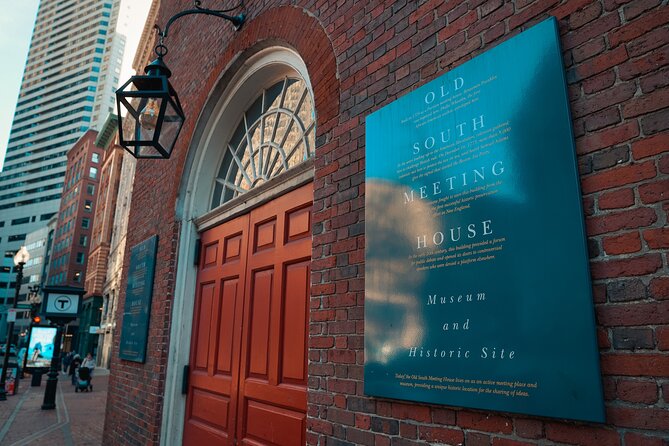
Reviewed · BOSTON TOURS
Boston’s Old State House & Old South Meeting House Museums
The Boston Tea Party began with people gathering to argue, and the Old South Meeting House is where those debates took shape. A visit here, paired with the Old State House two blocks away, links a striking colonial meeting hall with the seat of royal government and brings the Revolution’s big events down to human scale.
I like two things in particular: the buildings make the story tangible, from the Meeting House’s tall interior and parishioner boxes to the State House’s Revolution-era artifacts. I also like the freedom to explore at your own pace, with talks and tours available if you want more help connecting the details.
One consideration: this is not a continuous guided tour, and the Old State House is currently not accessible. The two museums are close together, but allow more than the bare minimum if you want time to read exhibits and take in both settings.
- The Boston Tea Party’s meeting place: Old South Meeting House was built in 1729 and hosted mass meetings that helped lead to the Tea Party and Revolution.
- The colonial government’s center: The Old State House, built in 1713, was the seat of royal government in Massachusetts Bay.
- Two sites, two blocks apart: You can visit both in a compact downtown walk.
- Self-guided, with added programming: Exhibits are easy to navigate, and talks and tours are also available.
- A practical price for two historic museums: The experience is listed at $15 per person, with time to explore both buildings.
- Different access at each site: Old South Meeting House is accessible; Old State House is not currently accessible.
Two buildings that tell opposite sides of the Revolution
These museums work best as a pair. At Old South Meeting House, people gathered to debate and organize; at the Old State House, royal authority had its headquarters. One building helps explain how dissent grew, while the other shows the government against which colonists were pushing.
That contrast gives the visit more shape than a collection of dates and artifacts. You can move from a room built for public discussion to the colonial seat of power, then think about how events such as the Boston Tea Party and Boston Massacre fit into the growing conflict.
Both museums sit in central downtown Boston, just two blocks apart. That makes this a useful stop if you are following the Freedom Trail or planning a day around nearby historic sites. It is easy to add the second building without turning the visit into a major trek.
The experience is self-guided, so you set the pace. You can move quickly through the displays or spend longer reading and looking closely. Talks and tours are available, but the visit does not require a guide to make sense of the main themes.
Old South Meeting House: where debate grew into action
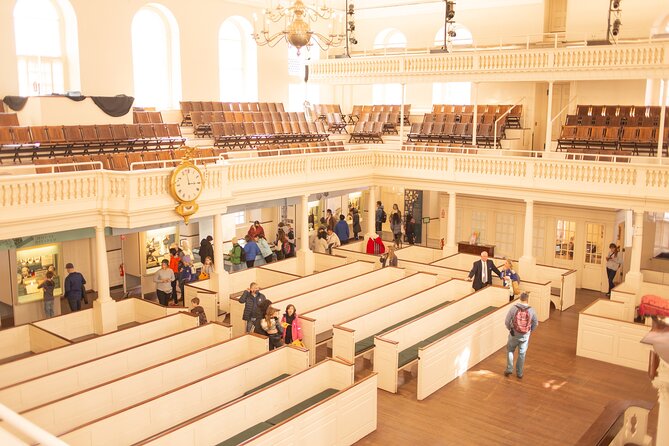
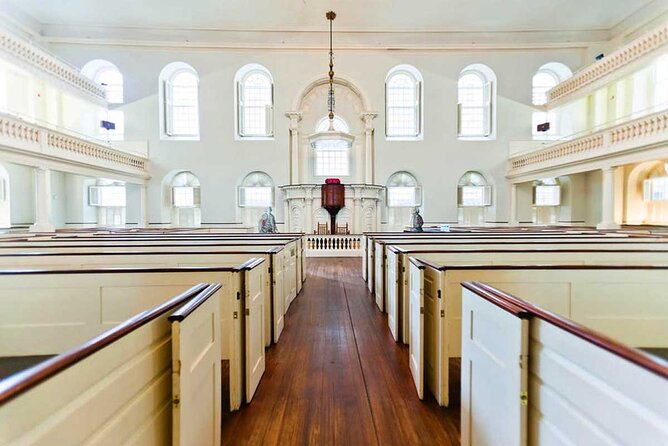
Built in 1729, Old South Meeting House was the largest building in colonial Boston. Its size mattered: it could hold the mass meetings where people gathered to discuss the events and decisions that helped lead to the Boston Tea Party and the American Revolution.
Inside, the scale of the building is part of the story. The Meeting House was a place of worship, but it also served as a space for public discussion. Its large interior and parishioner boxes give you a sense of a functioning historic church, not just a room where a famous event once happened.
This is the stop that makes the political story feel collective. The Boston Tea Party is often remembered as a dramatic act, but the Meeting House points to the conversations and shared opposition that came before it. If you are trying to understand how Boston’s resistance took shape, give this building more than a quick glance.
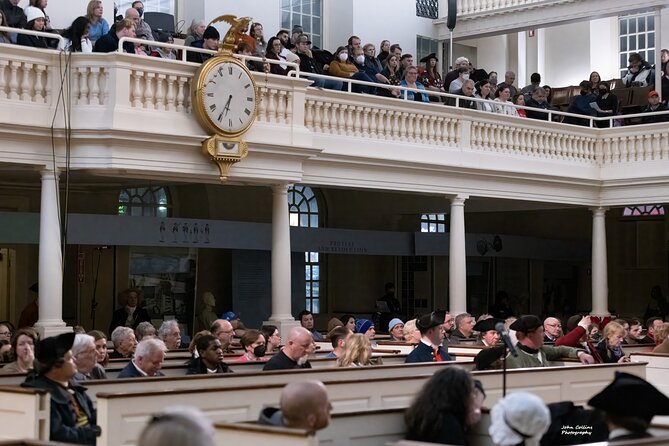
The museum presents exhibits and offers educational programs, public events, walking tours, and talks. Since the visit is self-guided, you can choose which displays to spend time with. Look for the details that connect the building’s original purpose with its role as a gathering place for civic debate.
Old South is also the accessible site of the pair. That distinction is important if you or someone in your group needs an accessible building. The Old State House is not currently accessible, so plan the visit with that limitation in mind.
More tours and days out around Boston:
- Boston Duck Boat Sightseeing City Tour with Cruise Along Charles River
★ 4.5 · 9,378 reviews - Boston: Freedom Trail History Small Group Walking Tour
★ 5.0 · 6,450 reviews - Boston Hop-On Hop-Off Trolley Tour with 13 Stops
★ 4.5 · 5,576 reviews
Old State House: the seat of royal government
The Old State House dates to 1713 and served as the center of royal government in the Massachusetts Bay colony. Its role gives this stop a different feel from the Meeting House: here, you are looking at the place where colonial authority was based, as well as a focal point for events that shook it.
The Boston Massacre is the defining event connected with the building. The museum helps place that event within the wider road to revolution, alongside artifacts and exhibits about the period. You will find more than a scenic old exterior here. The displays offer physical evidence of the people, objects, and political tensions behind the familiar story.
Give yourself about an hour if you want time to explore the exhibits. That estimate is useful for planning, but it is not a strict limit. A quick visit can work if you are fitting the museum into a busy downtown walk; history fans may want longer to read the material and study the artifacts.
The building is not currently accessible. This is the main practical drawback of visiting the pair, especially because Old South Meeting House is accessible and may initially make the two-site experience seem equally straightforward. If access is a concern, contact the museum before your visit to clarify what the limitation means for your needs.
Following the story from meeting hall to government center
The order of the two stops can change how the story lands. Starting at Old South Meeting House gives you the setting for debate and collective action, then the Old State House shows the government structure at the heart of the conflict. That sequence makes a clear narrative: first the gathering, then the institutions under pressure.
You can also begin at the State House if you want to start with the Boston Massacre and the formal center of colonial power. From there, Old South Meeting House offers a view of how public discussion and protest grew. There is no stated required order, and the short walk between them makes either approach easy.
The distance is a real advantage. Two blocks is close enough to keep the visit manageable, while still giving you a change of setting between museums. The stroll also leaves room to pause, take photographs, or orient yourself before going inside the next building.
Both sites are in the heart of downtown Boston, near public transportation. If you are already exploring central Boston, you can build them into a larger day rather than treating them as a separate excursion. The museums are also a sensible addition to a Freedom Trail walk, where their roles in the Revolution help connect other stops.
How much time to set aside
The stated duration ranges from about 30 minutes to two hours. The itinerary’s estimates suggest roughly 30 minutes at Old South Meeting House and an hour at the Old State House, but those are useful guideposts, not a timed group schedule.
If you have only half an hour, choose one museum and focus on its main themes. Trying to race through both can turn meaningful exhibits into a checklist. With around an hour and a half, you have a more comfortable chance to see both buildings, read some interpretive material, and pause at the displays that catch your eye.
History enthusiasts should leave extra time, especially at the State House, where the artifacts and Revolution-focused exhibits reward a slower look. If you have already taken a guided Boston history walk, you may find that background helps you place the museum displays in context. If not, the exhibits are still designed to be easy to navigate and understand.
Talks and tours are available, but no fixed schedule or guide names are provided. If live interpretation is important to you, check directly with the museum before you go rather than assuming a talk will be running at your preferred time.
Same city, a different kind of day:
- Boston: City Cruises Whale Watching Cruise
★ 4.5 · 4,710 reviews - Boston Duck Tour: The Original and World-Famous
★ 4.6 · 3,935 reviews - Harvard University Campus Guided Walking Tour
★ 4.5 · 3,632 reviews - Boston Fenway Park: Guided Ballpark Tour with Options
★ 4.8 · 3,606 reviews
What the $15 price gets you
At $15 per person, this is a modestly priced way to visit two important historic buildings in central Boston. You are paying for access to two museums, not a long coach trip or a guided tour that occupies half the day. The value comes from the connection between the sites, the exhibits, and the chance to explore at your own pace.
The brief walking distance helps the price go further. You do not need to budget much time for travel between stops, and the visit can fit around other downtown plans. For a history-focused day, the two museums offer a compact way to understand both the public gatherings and government institutions that shaped Boston’s Revolutionary story.
The experience is not a substitute for a live guide if you want a detailed narrative throughout. Its flexibility is part of the appeal, but it also means you need to read the displays and make your own connections. Talks and tours can add interpretation when available.
A few practical points before you go

From January 1 through June 30, 2026, both museums are listed as open daily from 10 a.m. to 5 p.m. Hours can change outside that period, so verify them if you are planning a visit for another date.
The experience includes a mobile ticket, and confirmation is provided at booking. Service animals are allowed, and the sites are near public transportation. Most people can participate, though the Old State House’s current access limitation is an important exception to keep in mind.
You can cancel for a full refund up to 24 hours before the experience begins. Cancellations or changes made within 24 hours are not accepted for a refund, and the cutoff uses local time. That policy gives you some flexibility, but it is worth checking your plans before the final day.
The museums are kept in good order, and the exhibits use visual material to support the history. Air conditioning is available at both sites, a welcome break during a warm day of walking around downtown. Photography is one of the stated highlights, particularly for the Revolution-era artifacts, though follow any instructions posted inside.
Who should make time for these museums?
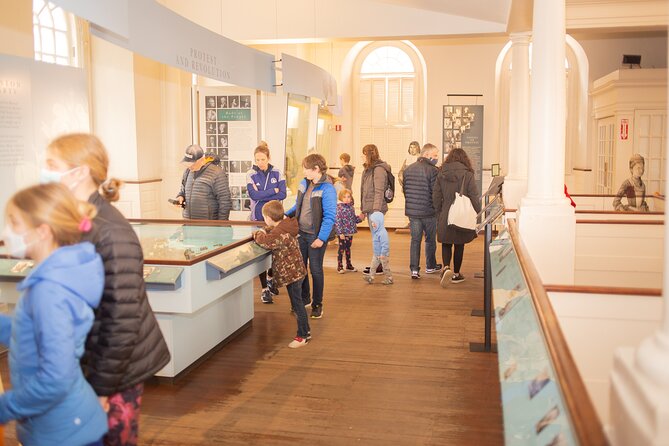
I would put these sites high on the list for anyone interested in the American Revolution, Boston’s political history, or the places behind familiar events. The visit is especially rewarding if you like historic buildings as well as exhibits, since the Meeting House itself helps explain how it could serve as a major public gathering place.
Families can also make good use of the flexible format. You can move through at a pace that suits your group, and the short walk between museums avoids a long transfer. The subject is serious, but the buildings and artifacts give younger visitors something concrete to look at while you explain the larger story.
If you prefer a guide to lead every step, this may feel quiet unless you catch a talk or tour. It is a museum visit first, not a continuously narrated walk. On the other hand, independent explorers can linger, skip ahead, and spend their time where their interest lies.
The 4.7 out of 5 rating from 23 reviews, with all recommending the experience, is encouraging, though the small number of ratings is worth keeping in perspective. The most useful takeaway is that the museums are straightforward to navigate, packed with historical information, and close enough to visit together without fuss.
Should you book the Old State House and Old South Meeting House?

Book this pair if you want a compact, self-guided look at the arguments, institutions, and artifacts behind Boston’s Revolution-era history. The two-block link between the buildings is practical, the $15 price is reasonable for two museums, and the contrast between the Meeting House and State House gives the visit a clear story.
Skip or reconsider the Old State House portion if its current lack of accessibility makes the visit unsuitable for your needs. And if you want a guide throughout, confirm whether a talk or tour fits your schedule. For everyone else, these museums are an easy and worthwhile way to add substance to a downtown Boston day.
FAQ
How much does the experience cost?
The listed price is $15 per person.
How long should I allow for the visit?
The experience takes about 30 minutes to two hours. Suggested time at the stops is 30 minutes at Old South Meeting House and one hour at the Old State House.
Are the museums guided tours?
The visit is self-guided. Talks and tours are also available, though specific times are not provided.
What are the opening hours?
From January 1 through June 30, 2026, the museums are open daily from 10 a.m. to 5 p.m.
Are both buildings accessible?
Old South Meeting House is accessible. Old State House is not currently accessible.
Can I cancel for a refund?
Yes. You can cancel at least 24 hours before the experience start time for a full refund. Cancellations made less than 24 hours before the start time are not refunded.
Just added around Boston
- Boston’s Freedom Trail: A Self-Guided Tour of All 16 Sites★ 5.0 · 14 reviews
- Boston’s Freedom Trail: A Self-Guided Audio Tour★ 4.0 · 18 reviews
- Private Walking tour of Boston’s Freedom Trail and more!★ 5.0 · 29 reviews
- Boston Self-Guided Audio Tour Bundle: Freedom Trail & More★ 4.5 · 5 reviews
- Washington D.C. Cherry Blossom,Baltimore 3-Day Tour from Boston★ 4.5 · 7 reviews
- Tour-in-Four — A Private four hour walking & driving city tour★ 5.0 · 32 reviews
- Freedom Trail Experience★ 5.0 · 8 reviews
- Tour de Cambridge Guided Bicycle Tour★ 5.0 · 34 reviews
Boston Tours, compared.

Boston Duck Boat Sightseeing City Tour with Cruise Along Charles River
Read our review →
Freedom Trail History Small Group Walking Tour
Read our review →
Boston Hop-On Hop-Off Trolley Tour with 13 Stops
Read our review →

Harvard University Campus Guided Walking Tour
Read our review →
Boston Fenway Park: Guided Ballpark Tour with Options
Read our review →
Boston to Martha’s Vineyard Day Trip with Optional Island Tour
Read our review →