
Reviewed · FREEDOM TRAIL TOURS
Downtown Freedom Trail Walking Tour – History & Architecture
Boston’s Revolution-era story is written right into downtown: in a cobblestone circle marking the Boston Massacre, on the balcony where the Declaration of Independence was read aloud, and in the ground beneath Boston Common. This 70-minute walk connects those places, with architecture and local stories alongside the familiar names.
I like two things in particular: the route brings together major landmarks and lesser-known stops, including the Old Corner Bookstore and the site of America’s first public school, and the small group limit can make it easier to hear questions and follow the guide. At $45, you’re paying for a focused introduction rather than admission to attractions.
One consideration: this is a brisk overview, not a long stop at every site. Guide quality and volume can vary, and you’ll be outdoors in all weather. Bring layers, arrive ready to walk, and ask early if you need the guide to speak up.
- A quick route through Boston’s revolutionary core: The walk covers the stretch between Faneuil Hall and Boston Common.
- A mix of famous and easy-to-miss stops: Look for the Boston Massacre marker, the Old Corner Bookstore, and the Boston Latin School site.
- Architecture is part of the story: The route includes buildings from different eras, from the 1713 Old State House to the French Second Empire Old City Hall.
- A small group, with a stated maximum of 20: A modest cap can help you stay close to the guide, though hearing clearly still matters.
- A useful first-day orientation: In just over an hour, you get names, places, and context to help you explore downtown afterward.
From State Street to Boston Common
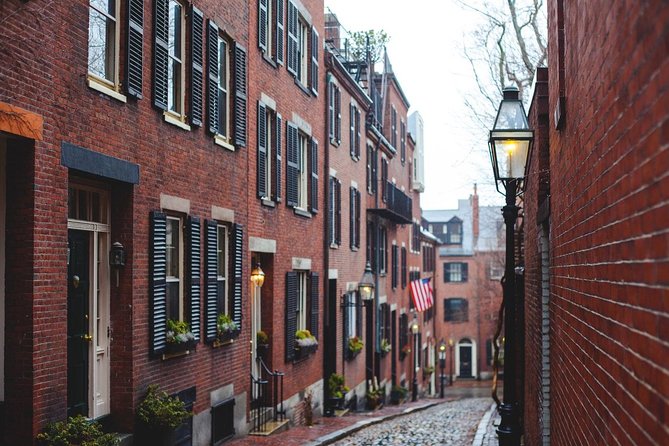
The tour meets at State Street and Congress Street at 10:00 am, in central Boston. From there, the route follows downtown’s Freedom Trail corridor toward Boston Common, passing landmarks that make the Revolution feel less like a chapter in a textbook and more like a chain of events unfolding on ordinary city streets.
The walk lasts about 70 minutes. That’s enough time for a useful overview, but not enough for lengthy visits inside every church, meeting house, or historic building. The experience is primarily a guided outdoor walk, so expect to view many places from the street rather than enter them.
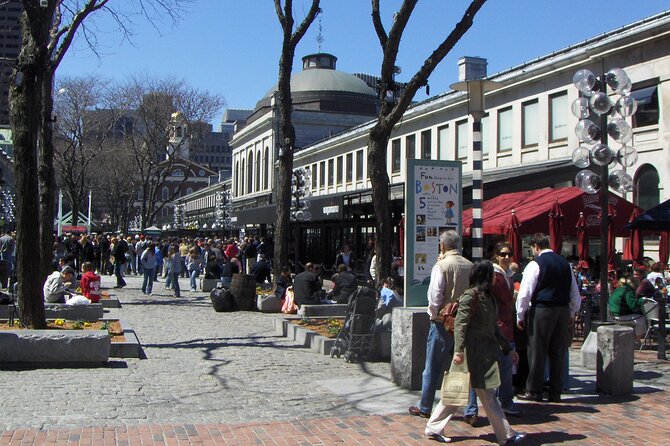
The stated route includes Faneuil Hall, Quincy Market, the Old State House, the Boston Massacre site, Old South Meeting House, Old Corner Bookstore, Old City Hall, the Boston Latin School site, King’s Chapel, Tremont Temple, Old Granary Cemetery, Park Street Church, the New State House, and Boston Common. That is a lot of ground and a lot of history for one short outing. I’d think of it as an introduction, not a deep visit to each stop.
The tour ends at Brewer Fountain near Boston Common. That gives you a convenient place to continue exploring the park or downtown on your own. The listed meeting and end points are different, so plan to finish near the Common rather than back where you started.
Faneuil Hall and the first sparks of protest
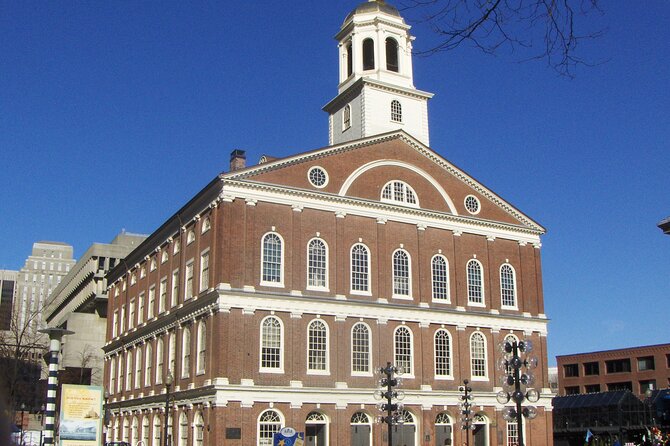
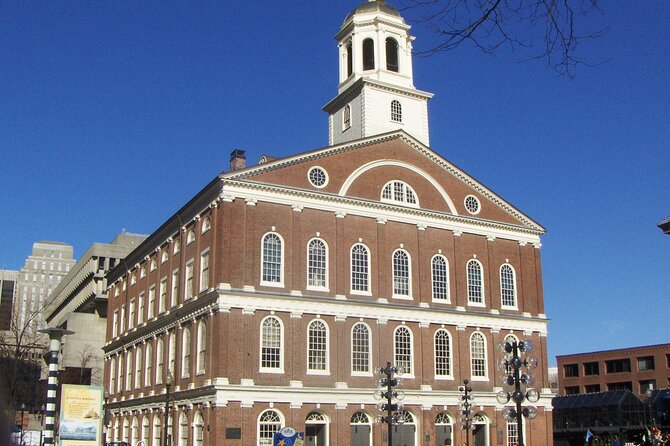
Faneuil Hall is often called the Cradle of Liberty, and it earns the name through its role as a meeting place for public debate and protest. Your guide connects the marketplace to the political tensions that fed the Revolution. Look up, too: the building’s famous grasshopper weathervane is an easy detail to miss if you keep your eyes on the crowd below.
Quincy Market sits nearby, adding another layer to the area’s long life as a center of commerce. The route passes both, but the tour’s value is less about shopping or food stops and more about understanding how public spaces became places to gather, argue, and organize.
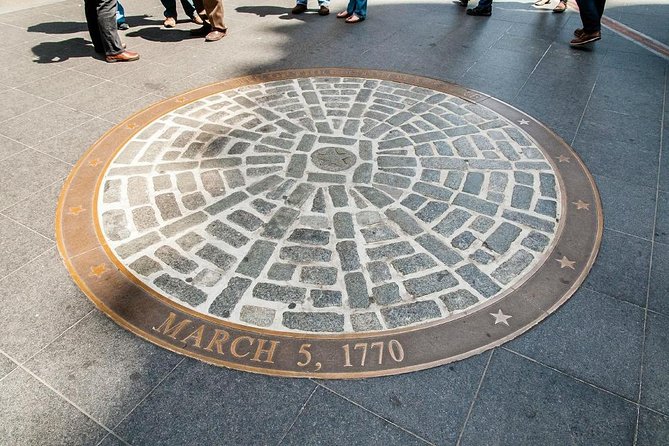
The Boston Massacre site is marked by a cobblestone ring in the pavement. In 1770, a clash between British soldiers and colonists here became a powerful symbol in the growing conflict. The marker is small, and the surrounding city is anything but frozen in time. That contrast is useful: the guide can help you picture the event without pretending the modern street has stopped moving.
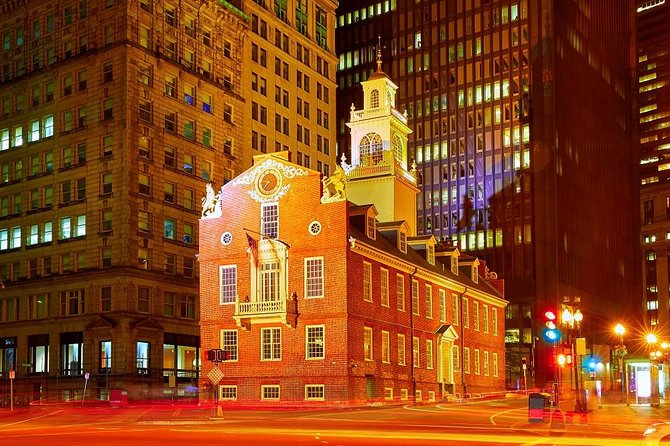
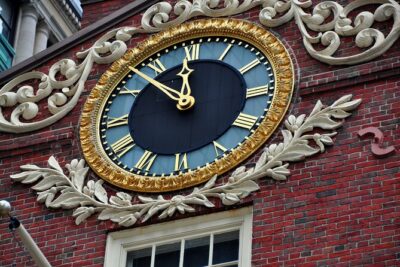
The Old State House, built in 1713, was the seat of British colonial government. The Declaration of Independence was read to Bostonians from its balcony. Standing outside, you can see how close the centers of government, commerce, and protest were to one another. That proximity helps explain why political news and public anger could move quickly through the city.
More Freedom Trail tours around Boston:
- Boston: Freedom Trail History Small Group Walking Tour
★ 5.0 · 6,450 reviews - Boston Freedom Trail Walking Tour with Costumed Guide
★ 4.5 · 2,531 reviews - Boston Food & History: Pizza, North End & Freedom Trail
★ 5.0 · 1,772 reviews
Meeting houses, booksellers, and Boston’s public life
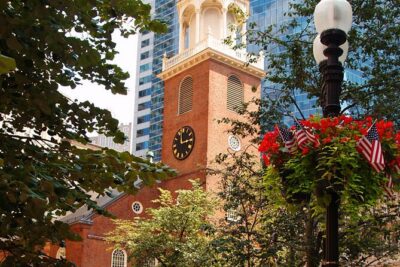
Old South Meeting House was a key gathering place in the years before the Revolution. Signals connected with the Boston Tea Party were given from its tower in 1773, linking this church to one of the best-known acts of colonial protest. The tour passes the building, but the short format means you should not expect a long interior visit.
The Old Corner Bookstore offers a different kind of story. Built in 1718 as a home and apothecary shop, it became a bookstore in 1828. Writers including Ralph Waldo Emerson and Charles Dickens gathered there. It’s a modest-looking building amid downtown traffic, but a reminder that Boston’s past includes literary circles as well as political ones.
A nearby stop is Old City Hall, which served as Boston’s city government from 1865 to 1969. Its French Second Empire design was among the first examples of that style in the United States. This is where the architecture side of the tour earns its place: you can compare a colonial building with a later civic structure and see how the city’s ambitions changed over time.
The Boston Irish Famine Memorial adds a more human and difficult chapter. Its paired groups of statues contrast an Irish family suffering during the famine of 1845 to 1852 with a prosperous family that immigrated to America. The memorial’s location between Washington and School streets makes it easy to pass by without noticing. It also broadens the route beyond the Revolution, showing how later migration shaped Boston.
A school site, a church, and stories of inclusion
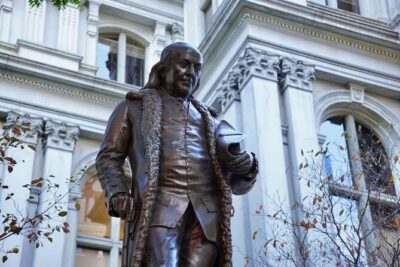
The Boston Latin School was founded in 1635 and is identified as the first public school in America. Its original School Street location is marked by a statue of alumnus Benjamin Franklin and a sidewalk mosaic. The school itself is not the focus here. Instead, the stop gives you a quick look at early ideas about education and civic life.
King’s Chapel dates to 1686 and has witnessed the city’s shift from British colony to independent nation. Its long history makes it one of the route’s most significant church stops. The tour can help you place it among the other religious buildings downtown, though time is limited, so you may want to return later if you’re keen to see more.
Tremont Temple has a notable history of racial inclusion. It began as the Free Baptist Church, formed after Timothy Gilbert objected to a Black family being excluded from his pew at another church. The congregation offered open attendance without charge and became known as the first integrated church in America. Its halls also hosted public events, including anti-slavery speeches by Frederick Douglass. This stop brings the route into the long struggle over equality, not just the fight for independence.
The tour also passes the Omni Parker House, founded in 1855 and described as the oldest continuously operating hotel in the United States. It is associated with Boston Cream Pie, Parker House Rolls, and the term scrod. These details make a pleasant change of pace from battles and political disputes, and show how local history keeps accumulating long after the Revolution.
Old Granary Cemetery and the approach to the Common
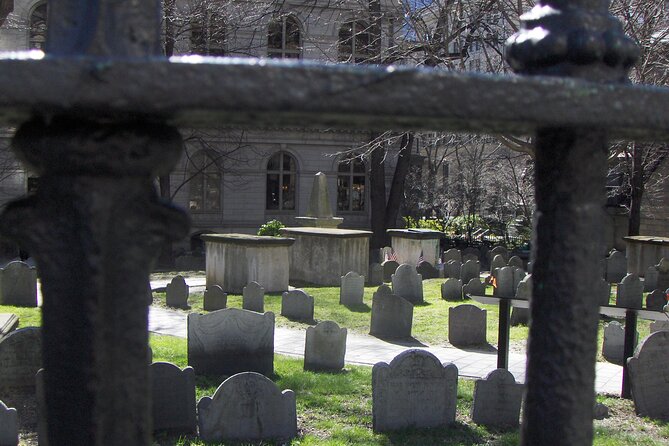
Old Granary Cemetery is the resting place of Paul Revere, Samuel Adams, and John Hancock. The cemetery is one of the most visited in the country, but the short tour may not leave time for a leisurely look at every grave. If a particular name matters to you, note it as the guide speaks and consider coming back after the walk.
Park Street Church marks the approach to Boston Common. The tour includes it among the downtown landmarks, alongside King’s Chapel and Tremont Temple, giving you a compact view of the city’s religious architecture and history. You’ll also hear about how different institutions shaped public life, though the balance between architectural detail and political history may depend on the guide.
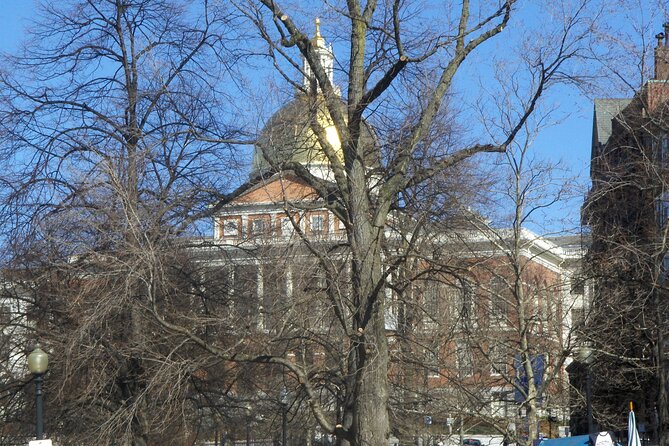
The New State House, built in 1798, is the later seat of Massachusetts government. Its 23-karat gold dome looks over Boston Common and gives the route a clear visual finish. From the colonial Old State House to this newer building, you see how authority shifted from British rule to local government.
Boston Common covers 50 acres and is the oldest city park in the United States. The tour ends near Brewer Fountain, giving you a natural place to pause after the walk. The Common is also an active public space, so demonstrations or events may be underway. These are outside the guide’s control and can affect the final stretch.
More history tours around Boston:
- Tour of Historic Fenway Park, America’s Most Beloved Ballpark
★ 4.5 · 3,013 reviews - The Full Revolutionary Story Epic Small Group Boston Walking Tour
★ 5.0 · 2,356 reviews - Boston: City Cruises Historical Sightseeing Cruise
★ 4.6 · 1,771 reviews - Boston’s Freedom Trail: A Revolutionary Walking Tour
★ 4.9 · 1,748 reviews
How the guide shapes the experience
The best version of this walk is not a list of dates. It is a guide who links a building to a person, a street corner to a turning point, and a historic event to the city you see today. Past guides Alan and Andrew have been praised for clear storytelling, humor, and a knack for engaging children. The guide on your date may be someone else, so don’t book expecting one particular person.
Some visitors have found the guide difficult to hear, especially in busy streets. Others have wanted more history or more attention to architecture. That variation matters on a walking tour, where the guide is the main event. If you’re struggling to hear, say so early and move closer; the group is capped at 20, but street noise can still interfere.
Families can bring children, who must be accompanied by an adult. Some guides involve younger participants by asking questions, which can make the history more accessible, though a child who prefers to listen quietly may not enjoy being singled out. The tour is offered in English, and most people can participate.
Is $45 a fair price for 70 minutes?
At $45 per person, this is not the cheapest way to walk the Freedom Trail. You can follow the route independently, but a guide adds context and helps you connect sites that otherwise may look like a row of old buildings and markers. If you are new to Boston, that explanation can save you time and give the rest of your visit more shape.
The price covers a professional guide and the 70-minute walking tour. Attraction admission is listed as free, and the experience is described as passing landmarks, not providing entry to them. So the value rests on the quality of the narration and the number of useful connections you take away.
A longer continuation has sometimes been offered for an additional $15, extending the walk beyond the downtown portion. That is not part of the stated 70-minute tour price, so confirm exactly what is included before agreeing to any extension or extra payment.
The tour is commonly booked well in advance, averaging about 55 days ahead. If your dates are fixed, booking early is sensible. You can cancel for a full refund up to 24 hours before the start time; within 24 hours, payment is not refunded. The tour operates in all weather, so dress for the forecast. If poor weather cancels it, you’ll be offered another date or a full refund.
Who should book this walk?
I’d choose this tour if you want a compact introduction to central Boston, especially on your first day. It suits history fans, first-time visitors, and families who want a guided route rather than a self-directed walk. The blend of revolutionary sites, churches, civic buildings, literary history, and the Common makes it more varied than a march from one famous marker to the next.
It’s less suitable if you want to enter every historic building, spend a long time at the cemetery, or hear a detailed account of every event. The schedule is short by design. If you have mobility or hearing concerns, check whether the walking format and outdoor setting will work for you, and tell the guide promptly if you cannot hear.
Book it for context, not access. At $45, the strongest reason to go is a good guide who makes downtown’s landmarks connect. If you prefer to explore at your own pace, follow the route independently and use the tour’s stop list as a guide to what you want to see.
FAQ
How long is the Downtown Freedom Trail tour?
The guided walk lasts about 1 hour and 10 minutes.
Where does the tour start and end?
It starts at State Street and Congress Street in Boston and ends at Brewer Fountain near Boston Common.
What time does the tour start?
The listed start time is 10:00 am.
What landmarks are included?
The route passes places including Faneuil Hall, Quincy Market, the Old State House, the Boston Massacre site, Old South Meeting House, King’s Chapel, Old Granary Cemetery, Park Street Church, the New State House, and Boston Common.
Is admission to the landmarks included?
The tour is a walking tour that passes landmarks. Attraction admission is listed as free, but entry to buildings is not described as included.
How large is the group?
The tour has a maximum of 20 travelers.
Is the tour suitable for children?
Children may participate, but they must be accompanied by an adult. Most travelers can participate.
What happens if the weather is poor?
The tour operates in all weather, so dress appropriately. If it is canceled due to poor weather, you’ll be offered a different date or a full refund.
More walking tours around Boston
- Harvard University Campus Guided Walking Tour
★ 4.5 · 3,632 reviews - Boston: Freedom Trail History Small Group Walking Tour
★ 4.9 · 1,590 reviews - Boston’s Freedom Trail: A Revolutionary Walking Tour
★ 5.0 · 1,343 reviews - Boston’s North End Food Tour: Italian Flavors & Heritage Walk
★ 5.0 · 1,322 reviews
Just added around Boston
- Boston’s Freedom Trail: A Self-Guided Tour of All 16 Sites★ 5.0 · 14 reviews
- Boston’s Freedom Trail: A Self-Guided Audio Tour★ 4.0 · 18 reviews
- Private Walking tour of Boston’s Freedom Trail and more!★ 5.0 · 29 reviews
- Boston Self-Guided Audio Tour Bundle: Freedom Trail & More★ 4.5 · 5 reviews
- Washington D.C. Cherry Blossom,Baltimore 3-Day Tour from Boston★ 4.5 · 7 reviews
- Tour-in-Four — A Private four hour walking & driving city tour★ 5.0 · 32 reviews
- Freedom Trail Experience★ 5.0 · 8 reviews
- Tour de Cambridge Guided Bicycle Tour★ 5.0 · 34 reviews
Freedom Trail Tours, compared.
Freedom Trail History Small Group Walking Tour
Read our review →
Boston Freedom Trail Walking Tour with Costumed Guide
Read our review →
Boston Food & History: Pizza, North End & Freedom Trail
Read our review →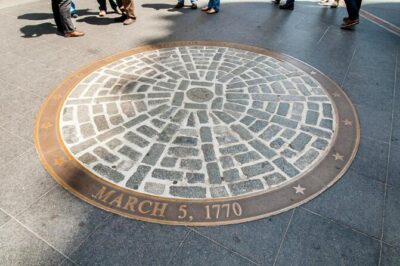
Boston’s Freedom Trail: A Revolutionary Walking Tour
Read our review →
Boston Freedom Trail History Pub Crawl Small-Group Tour
Read our review →
Entire Freedom Trail Walking Tour: Includes Bunker Hill and USS Constitution
Read our review →Browse the lists this tour appears in